
A way to plan content that turns into experience even when it fails
Hi there.
I'm Josh, and I run Marketer Haven, a career-growth blog for junior marketers.
While I was looking for content ideas to hit my 2024 goal of "building my own readership," it occurred to me that I could just share the whole process itself with other people.
I hope this helps anyone who has content planning and running a channel in mind, whether for a job as a content marketer or as a side project.
*Seth Godin's thinking was a huge help in putting this together. He's the author of This Is Marketing and the person who developed the idea of "permission marketing."
Step 1: Define the purpose and target of your content
Rather than vaguely deciding what kind of content to make, it starts with asking yourself this question.
"What do I ultimately need to get out of making this content?"
Good content is helpful to someone on its own, and it tends to have a quality that makes people want to see more of it, want to keep receiving it, or want to keep it to themselves.
And that leads to follow-on conversions like follows, subscriptions, inquiries, and payments.
That's why, to judge whether your content is genuinely useful, you need to define the performance metrics you're after, beyond basic "views" and "clicks."
Examples of performance metrics
1. Blog & Brunch (a Korean writing platform): subscribers, offline meetup attendance, paid content purchases
2. YouTube: subscribers, membership sign-ups, sales of linked products and events
3. Instagram: followers, sales of linked products and events
One thing not to misunderstand here: this doesn't mean you have to make money from your content.
What matters is that competitive content is at a level where "it's worth spending money or time on."
The second part is the "target."
To achieve the content purpose above, you have to decide "who you're going to satisfy."
Content that people keep coming back to usually has one thing in common: it solves a clear "pain point."
What successful content has in common
1. It provides information people were curious about but had no way to find out.
2. It raises the reader's standing.
3. It saves the reader time and money.
4. Even if it isn't hugely useful, it delivers a high level of satisfaction.
That's why you need to define specifically who you're actually capable of satisfying.
Content in marketing isn't primarily about making what the creator wants.
It's about making "content someone wants" in a way that's "true to you."
Keep in mind that the biggest reason content fails is that "it was made when nobody wanted it."
Step 1 in practice: "Build a blog that junior marketers subscribe to"
I didn't start my blog simply to help every junior marketer and job seeker. I started it to build solidarity with people who have a high chance of succeeding.
To make that happen, I decided to gather a lot of subscribers who actively seek out information and want new experiences and knowledge.
If I just answered questions as they came up in a "job seekers' KakaoTalk open chat" (KakaoTalk is Korea's dominant messenger), no real connection would ever form between me and my readers.
So I chose a blog platform that lets me ask for permission, "May I keep sending you blog posts that could be useful to you?", and collect email addresses.
I also carefully left a conversion point where people can become donors, "I don't take money, but I do accept coffee or fried chicken gift vouchers," in case I end up doing work that takes a lot of my time, like reviewing portfolios.
Step 2: Find your material - "Ask before you make it"
The way to avoid the biggest cause of failure I mentioned above, "content made when nobody wanted it," is simple.
You just ask before you make it.
Actually ask people who fit the target you set what they're curious about, or monitor the questions that come up in communities, and you'll find content material that "at the very least won't fail."
What matters here is that you, the one publishing the content, are clear about the boundaries of what you "know," what you "don't know," and what you "don't know but can find out."
Even without becoming an expert in a field, if you consistently answer what people are curious about right away, or look it up on their behalf, trust builds up, and that becomes a reason to subscribe or buy.
On the flip side, if you get greedy and pretend to know things you don't, you lose all the trust you've built up. Even the correct answers you gave before will be doubted.
How to organize the substance of valuable content
0. Basic principle: collect what people are curious about, the question marks.
1. What I know: things I've experienced firsthand or learned from experts' content
2. What I don't know but can find out: things I haven't experienced but can look up on someone's behalf
3. What I don't know: things I haven't experienced and can't find a clear answer to
-> Don't answer carelessly. Share it once I find out.
Step 2 in practice: What are junior marketers curious about?
Even before publishing this post, I'd been steadily answering junior marketers' questions in a marketer community of about 1,500 people.
Along the way, some people got to know me, and some started subscribing to my blog on their own.
To accelerate that in 2024, I decided to turn the things people are curious about into content more proactively.
Here's where a problem came up.
Even among junior marketers, the industries, fields, and goals they care about differ, and so does the information they want, by a lot.
Realistically, weekends are the only time I have to make content, so deciding what to make first was a really important question.
So I chose to "ask before making it."
I first listed the information I could offer to my audience, did an initial check on whether there was interest, and then asked the people who sent me a personal message which of those they wanted most.
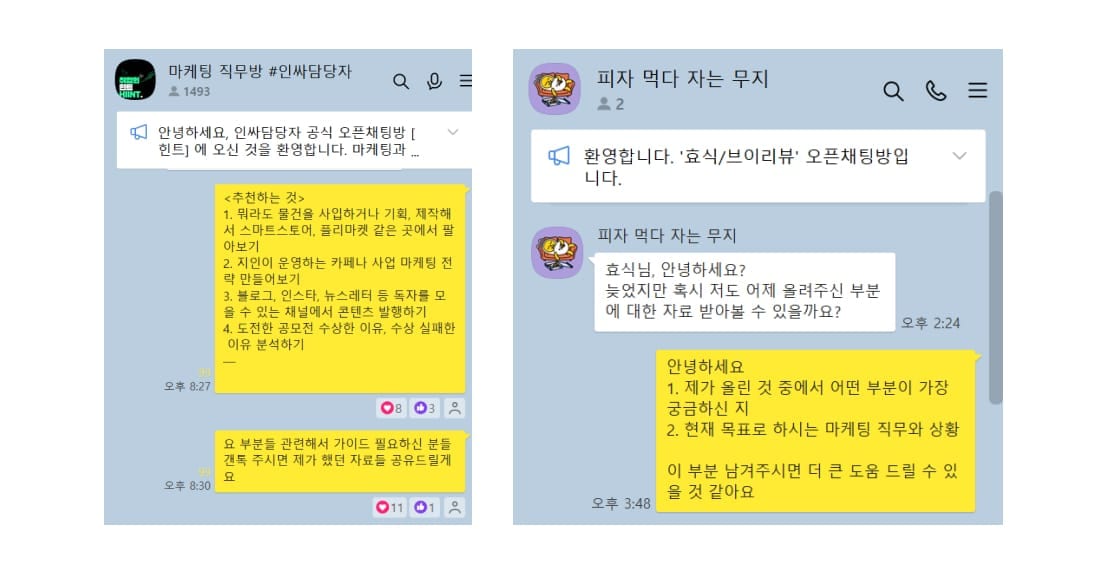
Through the first and second rounds of questions, I got a much clearer picture of what situations my potential subscribers are in and what they're curious about.
And if you publish content based on that, at the very least these people will be glad to receive it and will wait for the next one.
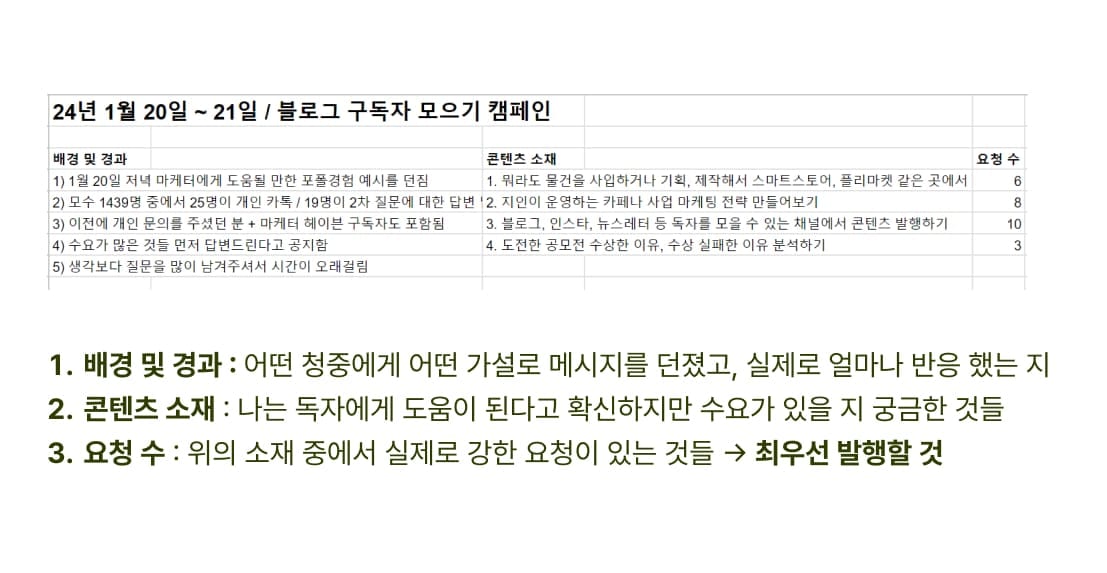
In other words, this process also goes a long way toward hitting the performance metrics we set at the very beginning.
It would have been hard with people who were just sitting in a group chat, but people who've crossed the threshold of a 1:1 message have momentum, and they become blog subscribers relatively easily.
And we get to make content that solves these people's problems.
Step 3: Make content that solves a sharply defined problem
Once you've found the content topics people want through Step 2, especially the ones they want to receive soonest, it's time to actually make the content.
Based on the topics and intent you asked your potential audience about above, organize the message of your post, video, or image as if you're showing it to one of them.
The advantage of content marketing is that even if you made it to solve one person's problem, if the content is effective, it can help other people at the same time.
Build your outline so you can deliver the information well, based on what you "know," what you "don't know but can find out," and what you "don't know," as mentioned above.
*For the record, the thing I don't know is "how to make entertaining content."
Then decide your publishing channel based on what format of information you mainly want to deliver.
The right content channel for each type of message
Image-based information: Instagram
Video: YouTube
Informational articles: a blog
Consistently delivering the latest information: a newsletter
Step 3 in practice: "How to plan content people care about before you even make it"
The very content you're reading right now is Step 3.
Through several rounds of Q&A, I learned that for the junior marketers and job seekers who will become my readers, the most important resource is time.
I judged that they want to build content experience they can put in a portfolio as quickly as possible, or that they need content planning skills for a job change or to expand their role.
So in the title, I emphasized that it can reduce the risk around time, and for the real-world example, I picked the approach from my own experience that had the lowest chance of failing.
Also, when I narrowed the topics down in Step 2, I only wrote down the ones where a blog would be the best delivery channel, so I was able to put this together quickly in writing without using Figma or Instagram.
Step 4: Evaluate and revise after you make it
Now deliver the content you've made to actual potential customers.
People can come across content through "organic exposure via algorithms" or "getting them to see it through ads," but those take time and money, and feedback isn't easy to get either.
On the other hand, content planned by asking before making it is perfect for leaving your audience with the questions "Is this what you wanted?" and "Is there anything more you want?"
Think of one full cycle as including revising the content with the feedback you get this way.
Hemingway, the author of The Old Man and the Sea, said "all first drafts are garbage."
No matter how hard you work on content, it's bound to be rough at first, so you need to publish with the mindset that you'll keep revising it.
Here, YouTube and Instagram are highly ephemeral channels, so you fold the feedback into making and distributing the next, more polished piece, while article-style blog content can simply be revised steadily after publishing.
For a newsletter, you can develop it by changing the layout, the order of the information, or the content itself based on feedback.
One more important thing is checking whether the KPIs you set in Step 1 are going up.
At minimum, the people who directly requested the content will contribute to hitting the KPIs, and by posting it in channels where your audience gathers, you can get more feedback and drive the KPIs up too.
Step 4 in practice: Throwing it into the sea where the audience is
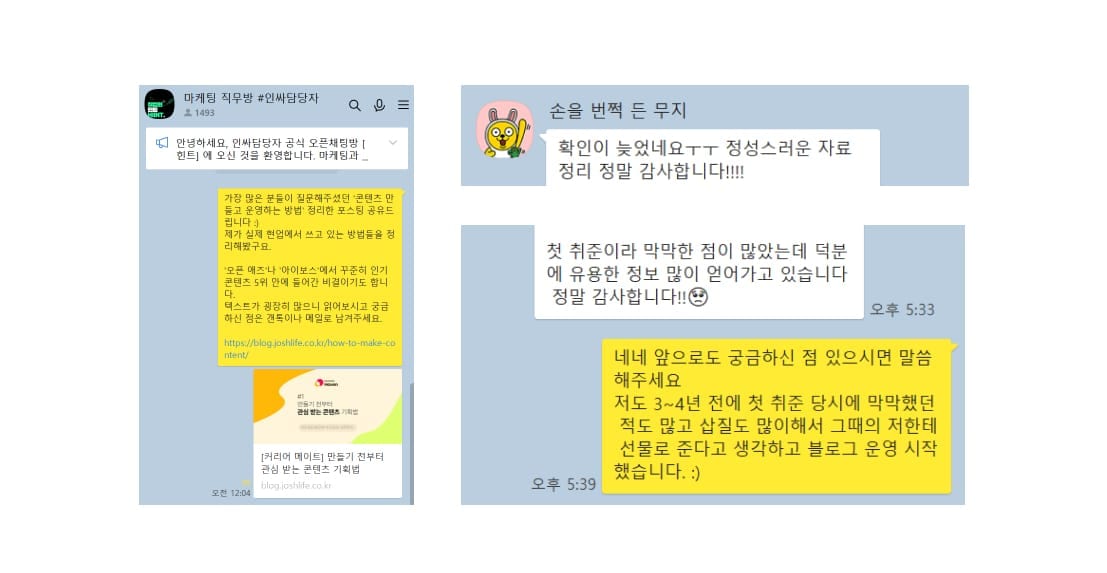
Now I throw the draft out to the people who sent me questions and to the channels.
Some will be satisfied, some will say thanks, but most will probably have no reaction at all.
Content was never meant to satisfy everyone, so I focus on answering the additional questions of the people who decided to subscribe.
Along the way, as explanatory images get added and dense sentences get rewritten more plainly, I'm hoping it will grow into increasingly valuable content.
Wrapping up: my first piece of content as a career mate
Honestly, publishing content this way isn't easy.
It's a far cry from the "cool, pretty content" we usually picture.
As I touched on above, the content a marketer makes as part of the job has to be about "what the customer wants to see," not "what I want to make."
And the simplest yet most powerful way to get there is what I talked about today: "asking before you make it."
Beyond this, I plan to keep sharing what I've studied about making good content here on the blog.
If you're interested, please hit subscribe using the button below.
Thanks for reading this long post!
What is Marketer Haven?
A haven means both a place of refuge and a harbor.
It exists to share information with junior marketers who are struggling with the job hunt and managing their careers, and to cheer them on at the starting line.The goal is to publish at least one piece of content every week 😀


