

"What actually changes when you do social data analysis?" Case studies answer that question better than feature descriptions do. So I gathered public cases based not on 'what was analyzed' but on 'what changed.'
The bottom line
In the public cases, the decisions that data changed fell into roughly three kinds. It changed direction (sampling strategy, product planning), set priorities (sensitive-product improvements, feature-by-feature reactions), or changed speed (global research timelines, issue detection). They share one thing in common: before deciding, they checked whether what was buzzing on social media matched what real customers were saying.
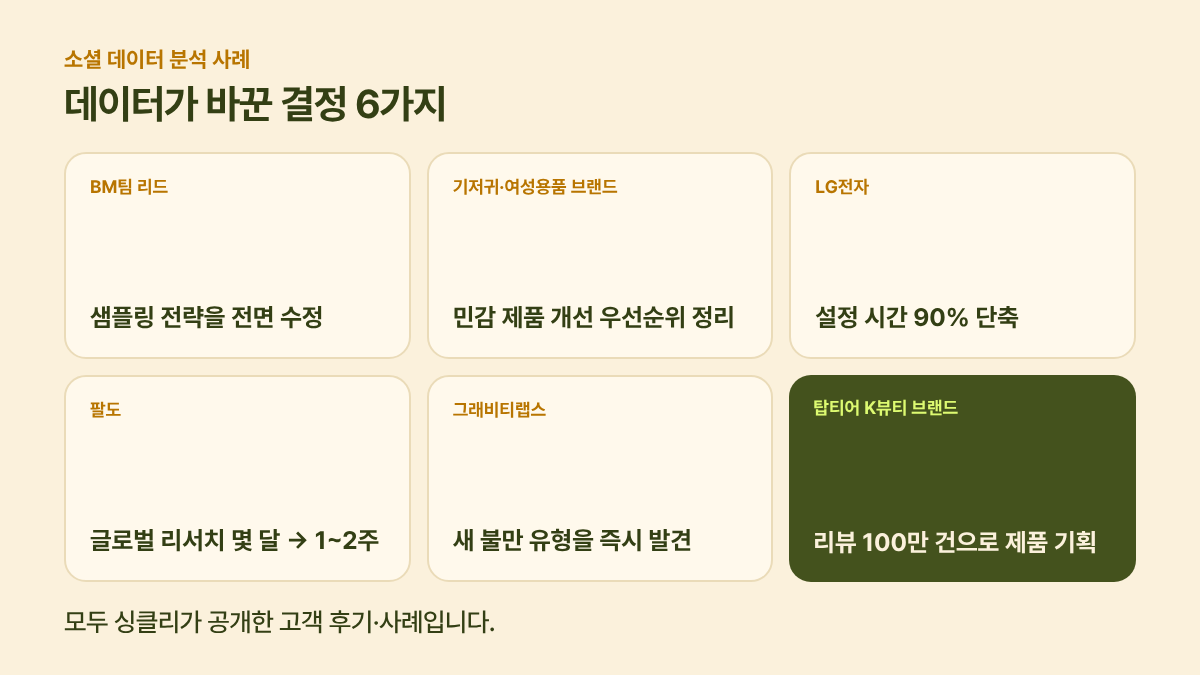
1. The BM team that overhauled its sampling strategy
- Situation: Based on social media reactions, they'd set 'blackheads' as the main message.
- Data examined: Actual consumer reviews.
- Decision changed: In the reviews, concerns about 'residue' and 'breakouts' loomed larger. They overhauled the sampling strategy from the ground up.
- Lesson: The words that go viral and the words that make people hesitate to buy can be different.
Source: Syncly Research Partners
2. The marketing communications department head who prioritized improvements for sensitive products
- Situation: Product categories like diapers and feminine care, where even small complaints can turn into big issues.
- Data examined: Internal VOC combined with external reviews and community posts.
- Decision changed: They organized the key complaints, strengths, and improvement priorities for diapers and feminine care at a glance, and named being able to respond first to risks in sensitive categories as the biggest help.
- Lesson: Internal support tickets alone show you the intensity of complaints, but the reasons quietly departing customers leave are outside.
Source: Syncly Research Partners
3. Paldo, which cut global research from months to 1~2 weeks
- Situation: Overseas consumer research took months at a time.
- Data examined: Qualitative data from global social and reviews.
- Decision changed: They finished the research in 1~2 weeks, with even the qualitative data delivered in an organized form.
- Lesson: When research takes less time, you can fit the findings into the actual decision schedule.
Source: Syncly Korea website
4. Gravity Labs, which spotted a new complaint type right away
- Situation: The problem of noticing customer issues too late.
- Data examined: Changes in customer feedback by type (the Trending tab).
- Decision changed: They immediately discovered a newly emerging complaint type, and the speed of issue detection increased dramatically.
- Lesson: A complaint that suddenly increases is often more urgent than the one that shows up most (see VOC analysis report).
Source: Syncly Korea website
5. LG Electronics, which broke reactions down by feature
- Situation: They wanted to use social reactions to their own and competing products for product development and marketing, but keyword setup was slow and sentence-level sentiment scores missed the context.
- Data examined: Posts on Facebook, Instagram, YouTube, X, and Reddit.
- Decision changed: They looked at feature-by-feature reactions using aspect-based sentiment analysis, which splits sentences into units of meaning. Syncly stated that the process from setup to insights went from months to about a week, and initial setup time dropped by 90% (company-reported figures).
- Lesson: A comparative sentence like "less bright than other products" may not be a complaint about the brand as a whole (see Sentiment analysis).
Source: LG Electronics case (Syncly blog)
6. The top-tier K-beauty brand that plans products with 1 million reviews
- Situation: A K-beauty brand that grounds its product planning in customer data.
- Data examined: More than 1 million accumulated reviews.
- Decision changed: They stated that every product is planned data-driven, from the customer's point of view.
- Lesson: When data analysis becomes a standard step in planning rather than a one-off project, reviews become an asset that grows as they accumulate.
Source: Syncly Korea website
Common patterns across the cases
| Pattern | Cases |
|---|---|
| The buzz and the real reasons for buying were different | 1, 5 |
| Internal data alone wasn't enough | 2 |
| Speed changed the quality of the decision | 3, 4 |
| Analysis became a process, not a one-off | 6 |
As an international example, the functional gum brand Neuro has also published a case in which it brought support tickets, reviews, and social feedback into a single dashboard, so that the CX, product, and marketing teams all look at the same customer data (Neuro case).
Alpaca's takeaway
A good analysis case is summed up not by a chart but by one changed decision. If any decision your team is about to make was based only on 'what's buzzing,' compare it against what real customers are saying before you decide. That question was the starting point for every case above.
🦙 That was Researcher Alpaca's research note. If anything is wrong or you'd like to know more, let me know via 'Contact Josh' below. I'll fold it into the next round of research.
Related reading
- Syncly review: which brands it fits, and when it doesn't
- New product market research: 4 steps you shouldn't skip before launch
Sources
- Syncly Korea website — testimonials from Paldo, Gravity Labs, and a K-beauty brand
- Syncly Research Partners — testimonials from a BM team lead and a marketing communications department head
- LG Electronics case (Syncly blog, January 2025) — aspect-based sentiment analysis, reduced setup time (company-reported)
- Neuro case (Syncly blog, June 2025) — unified feedback dashboard


