

If you searched for "Syncly," you're probably in one of these situations: someone recommended it, or you saw the name in an ad or at an event, and you want to know whether it fits your team. I'll lay it out as candidly as I can using only public sources.
The short version
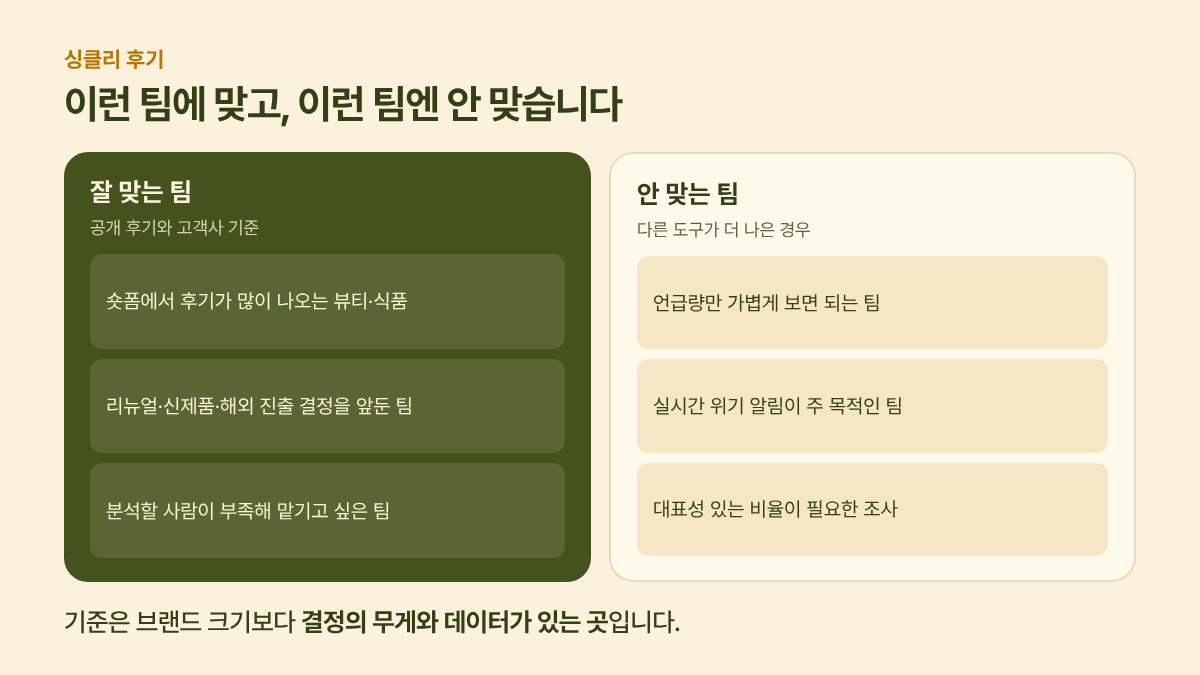
Syncly fits brands that need to make big decisions based on what customers say in short-form videos and reviews. If you're in a category like beauty or food where a lot of reviews show up on TikTok and Reels, if your team is heading into a relaunch, a new product or an overseas launch, or if you don't have enough people to do the analysis, it's worth taking a demo. On the other hand, if you only want a light read on mention volume, or your main goal is real-time crisis alerts, other tools are a better fit.
What Syncly is
Syncly is an AI customer data analysis service built by DeepBlueDot Inc., and it's backed by Y Combinator (Syncly website). Here's the publicly listed lineup.
| Service | What it does |
|---|---|
| Syncly Social | Social listening that analyzes the audio (STT) and even the visuals (AI Vision) in TikTok, Reels and Shorts videos |
| Syncly Creator | Finds TikTok and Reels influencers for product seeding |
| Customer data integration | Connects support tickets and e-commerce reviews for automatic collection and topic classification |
| Hey Syncly | Ask a question in plain language and it builds a report for you |
| Research Partners | Done-for-you analysis where a dedicated consultant handles everything from defining the question to the report |
Research Partners is described as a four-week process (week 1: define the question and collect data; weeks 2–3: analysis; week 4: final report), and they say you get the full raw data plus dashboard access for the following two months (Research Partners). For English-speaking markets, they also introduce a remote MCP feature that connects your data to Claude and ChatGPT (Syncly).
Publicly available customer reviews
| Who | What changed |
|---|---|
| CEO staff at a top-tier K-beauty brand | Plans every product with customer-perspective data; has gone through more than 1 million reviews cumulatively |
| Management support team at Paldo (a Korean food company) | Finished global consumer research that used to take months in 1–2 weeks, with the qualitative data organized too |
| CX manager at Gravity Labs | Spotted newly emerging complaint types right away through the Trending tab, faster issue detection |
| BM team lead | Social media was all about blackheads, but reviews showed bigger concerns about residue and breakouts, so they overhauled their sampling strategy |
| Head of marketing communications | Combined internal VOC with external reviews and communities to map the key complaints, strengths and improvement priorities for diapers and feminine care products, and addressed sensitive-product risks first |
The sources are the Syncly website and Research Partners. Published overseas cases include LG Electronics (aspect-based sentiment analysis) and Neuro, a functional gum brand (team-level feedback dashboards) (LG Electronics, Neuro).
Since the company picked these reviews, there's a chance only the good stories made it in. For a third-party take, G2 shows 4.9 out of 5 based on 15 reviews (as of October 2026, G2). That's not many reviews, so treat it as a reference point.
Strengths
- It reads what's said in videos. Catching products that are only mentioned out loud with no hashtag, or that only appear on screen, is the biggest difference from other tools (see the limits of hashtag analysis).
- It splits a single review line by attribute. "The scent is nice but the volume is disappointing" becomes scent (+) and volume (−), so you can see priorities (see sentiment analysis).
- You can hand it off. It doesn't just give you a tool; through Research Partners you can outsource the analysis itself, and you keep the raw data.
- It compares across countries. You can see reactions by country side by side on the same basis.
Weaknesses and when it doesn't fit
- Pricing isn't public. You can't sign up and start using it to gauge the cost the way you would with a self-serve tool; you have to go through a demo and a quote. What the cost depends on is covered in the cost of social listening.
- It's overkill for casual browsing. If all you need is mention volume trends, a self-serve tool in the tens-of-thousands-of-won-a-month range is better (see Sometrend vs. Syncly).
- If real-time crisis response is your main goal, an alert-driven monitoring tool is a better fit.
- For long time series on Korean blogs and cafés (online communities), or search journeys, Sometrend and Listening Mind are stronger (see comparing the three tools).
- If you need representative percentages, a survey is the right method.
What to check in a demo
- Search recent short-form videos for your product name and see whether it catches videos with no brand in the caption
- Whether you can jump straight from the results summary back to the source material (video or review)
- Whether you can set attribute classifications that fit your category
- What format you receive the raw data in
- What the cost depends on at your scale
Alpaca's takeaway
Syncly looks like a service for teams that need evidence for a decision, not a "rough vibe." Whether your team's next big decision is a relaunch or an overseas launch, if that decision needs what customers are saying in short-form video, check the five points above for yourself in a demo.
🦙 That's it for Researcher Alpaca's research notes. If anything is wrong or you have more questions, let me know through "Contact Josh" below. I'll fold it into the next round of research.
Related reading
- Sometrend vs. Syncly: which one fits your brand?
- How to pick a research firm: 7 things to check before you hand it off
Sources
- Syncly website — service lineup, customer reviews, Y Combinator
- Syncly Research Partners — process, deliverables, customer reviews
- Syncly — video analysis (STT, AI Vision), remote MCP
- LG Electronics case study (Syncly blog) — aspect-based sentiment analysis
- Neuro case study (Syncly blog) — team-level feedback dashboards
- Syncly reviews (G2) — 15 reviews, 4.9 rating


