

VOC here doesn't mean volatile organic compounds; it means the voice of the customer. It's the work of gathering and reading what customers say in support logs, reviews, surveys, social media, and short-form videos, and finding in them what we should change.
But most VOC analysis reports look alike: 78% positive, 22% negative, a word cloud of frequent terms, and "overall, the response is good." You nod along as you read, but nothing remains about what to do next week.
The short version
A good VOC analysis report shows on one page not what customers said, but what you're going to change because of it. The order is: a one-line conclusion → evidence (numbers by attribute plus customers' own words) → action items. This post gives you five steps for collecting, sorting, and reporting VOC, plus a one-page template you can use right away.
Where VOC lives
VOC is split between inside and outside the company. Look at only one side and your conclusion tilts.
| Where | Sources | What it shows well | What's easy to miss |
|---|---|---|---|
| Inside the company | Customer support logs, return and exchange reasons, survey responses | Problems during use, intensity of complaints | Customers who left quietly, hesitation before buying |
| Outside the company | E-commerce reviews, community posts | Reasons for buying, comparisons with competing products | Reviews left only as video |
| Outside the company (video) | TikTok, Reels, and Shorts reviews | Real usage scenes, first impressions, viral hooks | Products mentioned only verbally, without hashtags |
The head of marketing communications at one client company said that after combining internal VOC with external reviews and community posts, the key complaints and improvement priorities for diapers and feminine care products came into focus at a glance, so they could respond first to the risks around sensitive products (Syncly customer testimonial).
VOC analysis in five steps
- Decide the question you need to answer. Not "analyze VOC," but a single question like "What should we fix first in the next product refresh?" or "Did this campaign's message land with customers?" The first line of the report becomes the answer to that question.
- Collect, then filter. Pick the channels and time period that fit the question, and collect. Sponsored posts and paid-reviewer content, namesakes, and irrelevant mentions need to come out at this stage so the numbers later can be trusted.
- Split by attribute. Define attributes that fit the category, such as feel, effectiveness, scent, price, packaging, and shipping, and break each review down to the attribute level. "The scent is nice but there's not much of it" is two statements: scent (+) and quantity (−). Splitting sentences into units of meaning and reading sentiment per unit is called aspect-based sentiment analysis, and LG Electronics analyzed its reviews this way (Syncly blog).
- Prioritize. The most frequent complaint isn't always first. Look together at how often it appears, how serious it is (does it lead to refunds or to customers giving up on repurchasing?), and whether it grew since last time. A complaint with a small count that suddenly spiked is often the most urgent.
- Report with the original quotes attached. Next to "scent complaints doubled," attach two or three lines of what customers actually said. Numbers can be doubted, but a customer's sentence changes the air in the meeting room.
A one-page template you can use right away
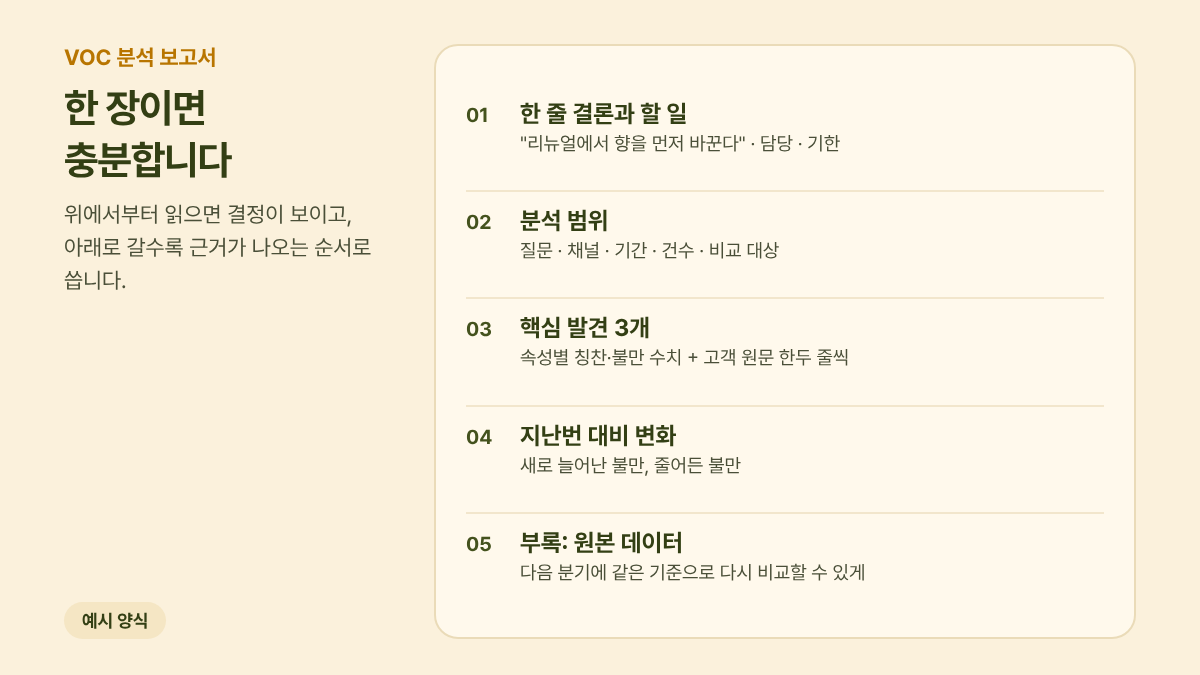
| # | Section | What goes in it |
|---|---|---|
| 1 | One-line conclusion and action items | "Change the scent first in the refresh" + owner + deadline |
| 2 | Scope of analysis | Question, channels, period, number of items, comparison set |
| 3 | Three key findings | Praise and complaint figures by attribute + one or two lines of customer quotes each |
| 4 | Changes since last time | Complaints that newly grew, complaints that shrank |
| 5 | Appendix: raw data | So you can compare again next quarter on the same basis |
It's best not to go past three key findings. Write seven and nothing changes.
Four common mistakes
- Looking only at the average star rating. A 4.6 tells you nothing. The most important complaint is often hiding inside a 4-star review.
- Stopping at the positive/negative ratio. "82% positive" can't be a report's conclusion. The conclusion is what people are positive about, and where the 18% negative is concentrated.
- Reporting numbers without quotes. A numbers-only report collapses at a single remark: "Isn't the sample off?"
- Changing the criteria every time. If the attribute categories and time periods differ every month, you can't see change. Keep the first report's categories as they are, and keep the raw data.
Do it yourself, or outsource it?
If you have a few hundred reviews across one or two Korean channels, doing it yourself in Excel is plenty. Pasting reviews into an AI like ChatGPT gets you a direction fast, but it only sees the reviews you pasted, and it's hard to trace back to the original text.
When reviews run into the thousands, or you need to look at short-form video reviews and overseas reactions as well, it's time to consider a tool or an agency. Syncly brings internal VOC like support tickets and surveys together with e-commerce reviews and what's said in TikTok and Reels videos, and analyzes them in one place; its Research Partners service assigns a dedicated consultant who handles everything from defining the question to the report, and hands it over along with the raw data. Which is right for you is best decided by looking at the cost structure first.
- Social listening costs: six reasons prices differ from vendor to vendor
- Competitor analysis: what you miss if you only look at revenue and ads
Alpaca's takeaway
The end point of VOC analysis isn't the report; it's the one decision the report produces. This month, try filling in just one question and three key findings using the template above. Write it once more next month with the same template, and from then on VOC stops being a "summary of reactions" and becomes "tracking change."
🦙 That was Researcher Alpaca's research note. If anything is wrong or you have more questions, let me know via "Contact Josh" below. I'll fold it into the next round of research.
Sources
- Syncly Research Partners — customer testimonials and deliverables from combined analysis of internal VOC and external reviews
- LG Electronics case study (Syncly blog) — aspect-based sentiment analysis
- Syncly website — Syncly VOC: unified customer feedback


