

Three months before launch, you survey three concept mockups and option B wins. Then after launch, the most common thing in the reviews is something that wasn't in any of the three. It's a familiar scene in new product research. The problem wasn't a lack of research. It was asking before listening.
The short version
New product research fails less often when you do it in four steps: listen → narrow → ask → listen again. Find complaints in what customers have already said (listen), narrow two or three of them into hypotheses (narrow), measure the size of only those hypotheses with a survey (ask), and check the first reactions after launch using the same criteria (listen again). Failures mostly happen when you skip step 1 and start at step 3.
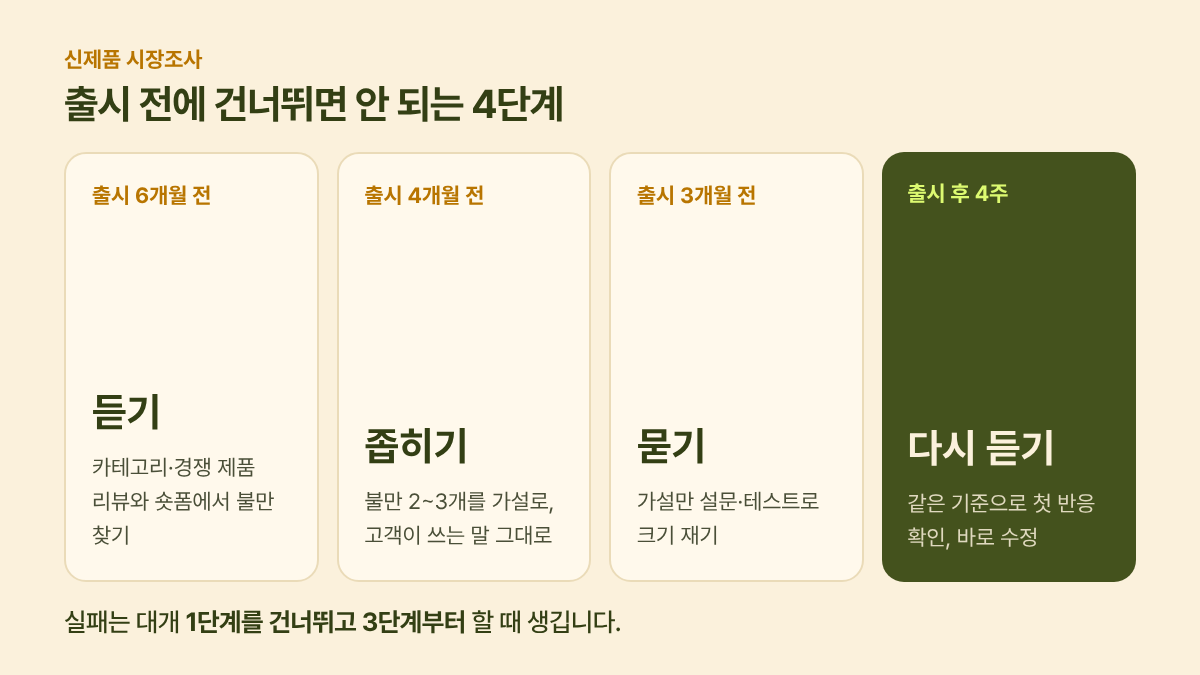
1. Listen (6 months before launch)
Sort customers' praise and complaints by attribute, drawing on reviews of the whole category and competing products, community posts, and short-form video reviews.
- Complaints that recur in reviews of the top 3~5 competing products
- The scenes in which customers use the product in short-form video, and the words they use
- Complaints that have spiked in the last 3~6 months
The BM team lead at one brand said that after focusing on blackheads based on social media reactions alone, they found that actual reviews showed much bigger concerns about "residue" and "breakouts," and overhauled their sampling strategy (Syncly customer story). The words that generate buzz and the words that decide a purchase can be different.
2. Narrow (4 months before launch)
Pick only two or three of the complaints from step 1 as hypotheses. Use three criteria.
- Is it frequent? Is there enough volume?
- Is it decisive? Does it lead to abandoned repurchases or refunds?
- Can we win on it? Can we solve it with ingredients, formulation, size, or price?
Write each hypothesis in the customer's own words. "It's sticky after I put it on and my makeup slides" works better than "improve absorption" as a survey option and as ad copy in the next step.
3. Ask (3 months before launch)
Now measure the size of your hypotheses with a survey or concept test. Because you've been through steps 1 and 2, the questionnaire is shorter and the answer options use customers' words. Panel surveys now collect responses in a matter of hours, and the cost is set by the number of questions and respondents, so cutting questions is the direct way to cut cost (see Market research costs). I covered why this order is right in detail in Surveys vs. social listening.
4. Listen again (4 weeks after launch)
Look at the reviews and short-form reactions from the first four weeks after launch using the same attributes as in step 1. Check whether your hypotheses held, whether unexpected complaints have appeared, and which videos and which words customers responded to, then apply it right away to the product detail page, ad creative, and the next production run. Amazon's 2026 Prime Day analysis found that new products launched within the past year drove K-beauty sales growth (Hankyung Business), which also means how you refine a new product in its first few weeks has become that much more important.
What happens when you skip a step
| Skipped step | Common result |
|---|---|
| Listen | Concepts cooked up in a conference room compete with each other, and what customers actually wanted isn't among the options |
| Narrow | You try to pack in all seven improvements and end up with a product where nothing stands out |
| Ask | You mistake a few voices for everyone and invest without knowing the size |
| Listen again | You miss the first reactions and the same complaints carry over into the next production run |
Alpaca's takeaway
The key to new product research is the order, not the amount. Before your next planning meeting, pull just three complaints from competitor reviews and write them down in the customers' own words. Those three lines become your survey questions, your concept, and your ad copy.
🦙 That's it for Researcher Alpaca's research notes. If anything's wrong or you want to know more, use 'Contact Josh' below to let me know. I'll factor it into my next round of research.
Related reading
- Surveys vs. social listening: which fits new product planning?
- Social data analysis cases: 6 decisions that data changed
Sources
- Syncly Research Partners — BM team lead's story (sampling strategy overhaul)
- Amazon announces K-beauty trends (Hankyung Business, Aug. 2026) — contribution of products launched within a year to Prime Day growth


