

"Brand hashtag posts are down 30% from last month." A report like that makes you anxious. But if, in the same month, more customers walked into your stores saying "I saw this on TikTok," then one of those two numbers is wrong. Usually the wrong one is the hashtag.
The short version
Analysis based on hashtags and captions counts only the people who typed the brand name out. In short-form video, customers introduce a product out loud, hold it up to the camera, and call it by a nickname. Those mentions aren't missed because the analysis is sloppy; they never enter the dataset at the collection stage in the first place. So the fix has to start with how you collect, not with the dashboard.
Why hashtags can't catch it
1. Collection starts from text. Most social listening matches keywords against captions, hashtags, and @mentions, and only pulls in the posts that match. A post that mentions the brand only inside the video never gets through that door. Even if a video analysis feature is bolted on later, if it only analyzes posts that were already filtered by text, the videos that got dropped don't come back.
2. Hashtags themselves are shrinking. In December 2025, Instagram announced it was capping hashtags in Reels and post captions at five, and began rolling the change out in stages (Garden Center report). Creators have less and less reason to spend one of five slots on your brand tag.
3. Short-form is a format for talking and showing. A video where someone holds a product up to the camera saying "this is seriously gentle" may never show the brand name in text even once.
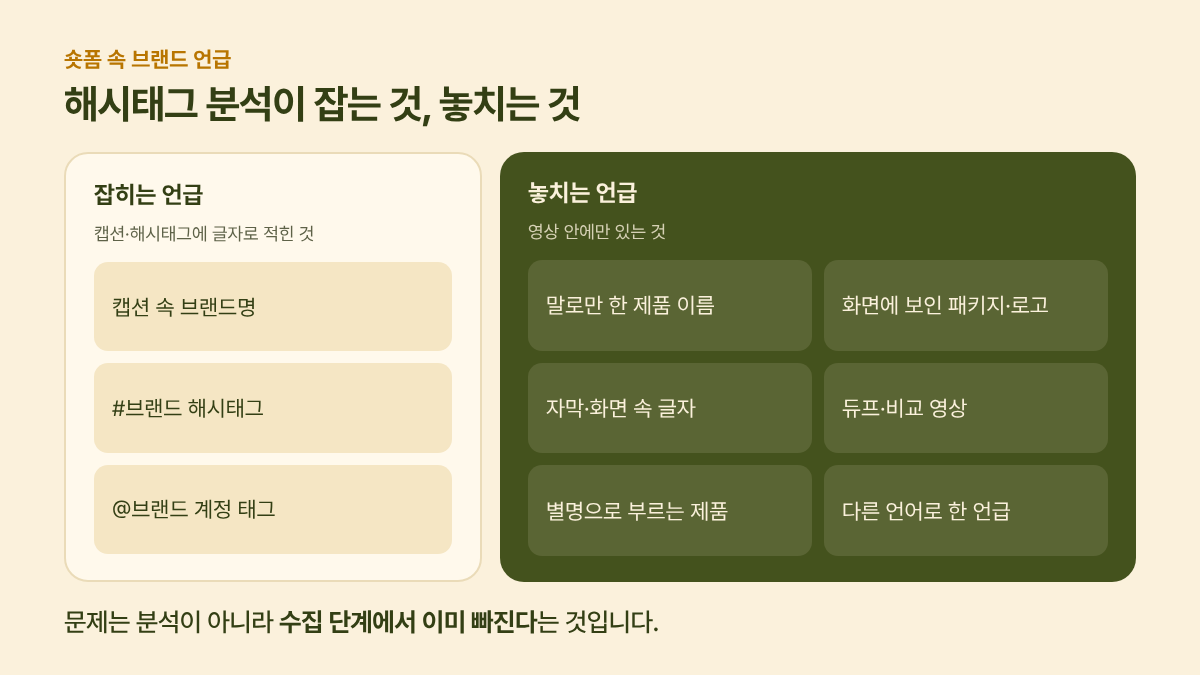
Six kinds of mentions that happen outside hashtags
| Type | Example | In hashtag analysis |
|---|---|---|
| Product name said out loud only | "I only use ○○ sunscreen these days" (not in the caption) | Not captured |
| Packaging or logo shown on screen | A product pulled out of a pouch appears only on screen | Not captured |
| Text in subtitles or on screen | Product name appears only in on-screen captions or a price tag | Not captured |
| Dupe and comparison videos | Two products side by side: "this one's the dupe for that one" | The compared product is missed |
| Products called by nicknames | A nickname based on color or texture | Captured only if you know the nickname in advance |
| Mentions in other languages | An overseas creator introduces it in their own language | Captured only if you add keywords for every language |
This list is a brand-marketer's condensed version of the types of short-form mentions social listening misses that the Syncly blog compiled.
Three illusions this creates
- The illusion that mentions dropped. If fewer people use hashtags, the number falls even when the actual conversation is unchanged. The 30% drop report above is an example.
- The share-of-voice (SOV) illusion. If a competitor runs more tag campaigns, its share comes out higher regardless of the actual volume of conversation.
- The sentiment illusion. Posts that tag the brand precisely are more likely to come from the brand account, sponsored content, and product-seeding programs. Looking only at tagged posts, the reaction can look better than it really is, or the tone of sponsored content can pass for how customers actually talk.
How much is our brand missing? A 30-minute check
There's no reliable industry statistic yet on what percentage gets missed. So measuring it on your own brand is the most accurate option.
- On TikTok and Reels, search for your product name and the nicknames customers use, and open the 30 most recent videos.
- For each video, mark whether the brand name appears in the caption or hashtags.
- Count the share of videos where it doesn't. That share is what your hashtag analysis currently can't see.
Because this check only looks at the top search results, it isn't a precise figure, but it's enough to get a feel for how much to trust your hashtag reports. Syncly states that video-first collection captures 3 to 4 times more brand mentions, though that's a number put forward by the company itself (Syncly blog).
The fix starts with collection
To catch mentions inside videos, you have to pull in the video and read it before matching on text. Three methods are used together.
- Speech to text: Transcribe what's said in the video and look for brand names.
- Reading on-screen text: Read subtitles, price tags, and text written on the screen.
- Recognizing logos and packaging: Find products that appear only on screen, without being named.
When evaluating tools, ask this before "Do you do video analysis?": Do you also collect videos where the brand isn't in the caption? If the approach only runs video analysis on posts already filtered by text, the missed videos stay missed. Syncly's approach analyzes the audio and imagery inside TikTok, Reels, and Shorts videos, and collects videos where the brand is only mentioned verbally, with no hashtag.
When hashtag analysis is enough
Not every team needs video analysis.
- When you're measuring participation in a hashtag challenge or campaign the brand itself launched
- When you're in a category where reviews come mainly as text on blogs and communities
- When you only need to track official-account tags and sponsored-content performance separately
In those cases, hashtag analysis is the fastest and cheapest option. On the other hand, in categories like beauty, fashion, and food, where a lot of reviews happen in short-form video, it's safer to treat hashtag numbers as "for reference only."
Alpaca's wrap-up
Hashtags were name tags that customers attached for the brand's sake. Now that those name tags are disappearing, judging your brand's reception by hashtag counts alone could mean missing the liveliest conversations. Start with the 30-minute check above this week.
🦙 That was a research note from Researcher Alpaca. If you spot a mistake or have more questions, let us know via "Contact Josh" below. I'll fold it into the next piece of research.
Related reading
- VOC analysis reports: how to write one that leads to decisions, plus a template
- Sometrend vs. Syncly: which one is right for our brand?
Sources
- Instagram's new hashtag limits (Garden Center) — five-hashtag cap on captions, phased rollout
- 10 Short-Form Video Mentions Social Listening Misses (Syncly, May 2026) — types of mentions that get missed
- Untagged Mentions: Why Social Listening Never Collects Them (Syncly, Aug 2026) — omissions at the collection stage, 3 to 4 times (company-provided figure)
- Syncly job posting (Remember, Korean) — analysis of audio and imagery inside videos


