

The bottom line first: these two tools don't answer the same question
Sometrend is a tool for quickly checking, on your own, how much something is mentioned and alongside which words. Syncly is closer to a tool that answers why customers say what they say, and therefore what you should change, including what's spoken inside TikTok and Reels videos.
If you're scanning trends and need numbers to drop into a proposal, Sometrend is far lighter and more sensible. On the other hand, if you need to walk into a decision like new product direction or a competitive response carrying evidence, an approach like Syncly's is worth considering even at a higher cost.
Side-by-side comparison
The biggest differences are where the data comes from and who does the analysis. Based on each company's official pages as of October 2026.
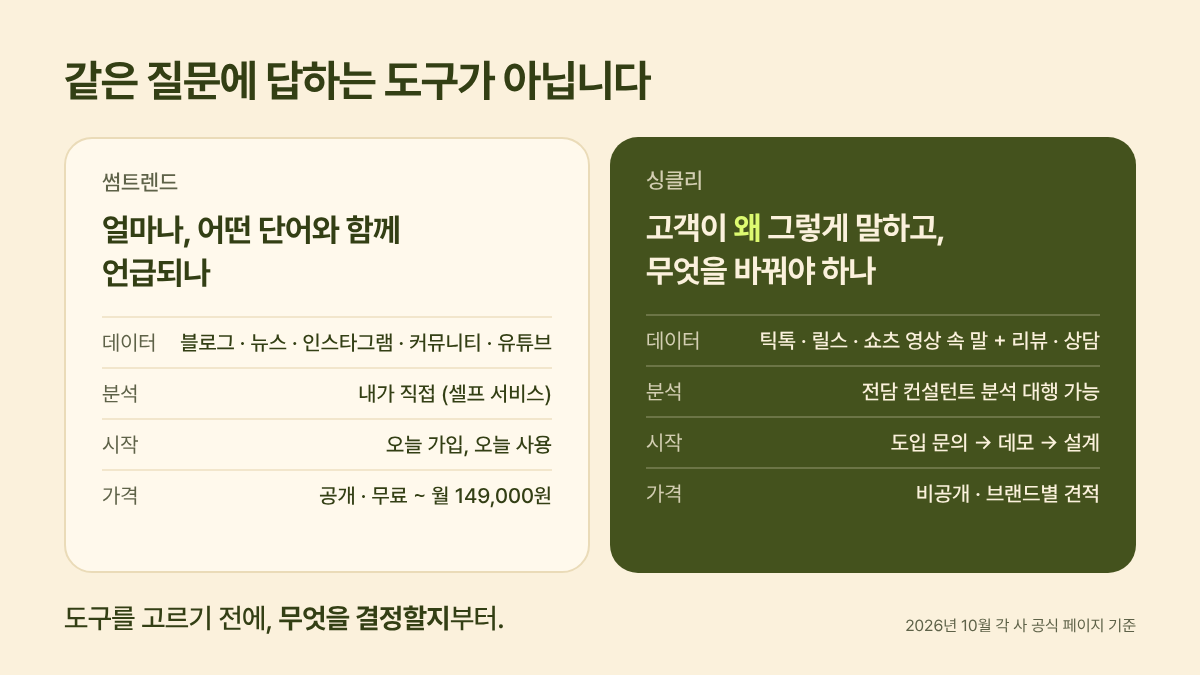
| Item | Sometrend | Syncly |
|---|---|---|
| One-line definition | Korean social big data trend analysis service | Video-first AI social listening + integrated customer data analysis |
| Main data | Blogs, news, Instagram, communities, YouTube, cafes (varies by plan) | TikTok, Reels, Shorts videos; e-commerce reviews; first-party data such as support logs and surveys |
| Video analysis | No mention of in-video speech analysis on the official page | Analyzes speech and on-screen content in videos (captures mentions without hashtags) |
| Data history | Accumulated since 2008 (lookup range varies by plan) | Designed per project and contract scope |
| Country coverage | Centered on Korean channels; for beauty, 'Beauty MCP' covers Instagram and TikTok data from 120+ countries (from July 2026) | Supports country-by-country comparative analysis |
| Analysis method | Self-service (mention volume, associated words, sentiment, AI reports) | Dashboard and natural-language questions + dedicated consultant analysis (Research Partners) |
| Deliverables | Charts, Excel download (Premium and up), AI reports | PDF report + dashboard + full raw data |
| AI connection | ChatGPT app, Claude MCP connection | Natural-language questions (Hey Syncly), Claude and ChatGPT MCP connection |
| Pricing disclosure | Public (Free; Basic 29,700 won/month; Premium 149,000 won/month; Enterprise by quote) | Not public (social listening through sales inquiry) |
| How to start | Sign up and use right away; 7-day Premium trial | Inquiry, then demo |
What Sometrend does well, and where it falls short
Sometrend's biggest advantage is that you can sign up today and use it today. No need to ask anyone. Type in a keyword and the mention trend and associated words appear immediately.
What it does well
- Low barrier to entry: There's a free plan, with Basic at 29,700 won/month and Premium at 149,000 won/month. Premium also comes with a 7-day trial.
- Long data history: With data accumulated since 2008, you can see multi-year trends (lookup range varies by plan).
- Strong on Korean text channels: It covers the long-form writing Korean consumers produce on blogs, news, communities, and cafes.
- Familiar language: Figures like "mentions rose X% versus last month" transfer straight into reports and proposals.
- AI tool connections: Approved as a ChatGPT app in 2026 and connected to Claude as well, so you can ask about trends conversationally.
What may feel like limitations
- The "why" behind the numbers is on you. Even if "moisturizing" shows up as an associated word, you have to read the original posts one by one to know whether it's praise or a complaint, and in what usage context it came up.
- Speech in videos may slip through. The official page doesn't describe speech analysis for TikTok or Reels videos. If your category is one where beauty or consumer-goods reviews now show up more in video than text, this gap gets bigger.
- International coverage is expanding, starting with beauty. In July 2026 Sometrend opened a paid 'Beauty MCP' that lets you see Instagram and TikTok data from more than 120 countries inside ChatGPT and Claude, broken down by country distribution, product, and ingredient associations (VentureSquare). However, it's only described as "multimodal data," so whether it transcribes and analyzes speech inside videos can't be confirmed from public sources, and categories outside beauty are still centered on Korean channels.
- In the end, you do the analysis. Because it's self-service, keyword design, noise removal, and interpretation depend on the time and skill of the person in charge.
What Syncly does well, and where it falls short
Syncly is less a tool for casual browsing and more one for backing a brand's important decisions with evidence. The client names listed on its homepage make that character clearer: global high-end brands like Tiffany & Co., Burberry, Fenty Beauty, and Kylie Cosmetics; large Korean conglomerates like Samsung, LG Electronics, LG H&H, and CJ CheilJedang; global K-beauty brands like Beauty of Joseon, Celimax, and Purito; and Cheil Worldwide, Korea's leading agency. These are all teams that don't make decisions on a "rough vibe," and Syncly appears to be a tool built to handle that level of analysis.
What it does well
- It reads what's said in videos. It analyzes cases where a product is only mentioned verbally or only shown on screen in TikTok, Reels, and Shorts. The key point is that it captures reviews that were never hashtagged.
- It pulls scattered customer data into one place. It looks at social reactions together with e-commerce reviews and first-party data like support logs and surveys. One top-tier K-beauty brand said it plans every product this way and has gone through more than one million cumulative reviews with Syncly. It's a case where the tool isn't used once and dropped, but has become a standard step in product planning.
- It compares across countries. A food company's business support team wrote that global consumer research that used to take months was finished in one to two weeks, and that leadership was satisfied with the results.
- You can hand off the analysis. 'Research Partners' has a dedicated consultant handle everything from defining the question to the report. Syncly says it delivers a first report within 1.5 weeks on average and a final report within 4 weeks, and hands over all raw data as well. Instead of learning a tool, the person in charge can focus on questions and judgment.
- Original posts and insights stay attached. For a question like "What are our strengths versus competitors?" it shows the supporting posts alongside, so you can tell your CEO, "Here's what customers actually said."
What may feel like limitations
- Pricing isn't public, and it isn't cheap. Social listening quotes are only available through a sales inquiry. For a team that just wants to check mention volume for a few tens of thousands of won a month, it's overkill.
- You can't use it today. It goes through an inquiry, a demo, and a design process. If you need a number for tomorrow's report, it's not the right fit.
- Decade-long time series of Korean blogs and cafes are Sometrend's territory. Syncly centers on video and reviews, so its strengths show less when you want to look at very long text trends.
If you're curious what comes out for your own brand, request a Syncly demo and ask them to show it with your brand and a competitor.
What drives the cost
Sometrend has a public price list, and Syncly quotes each brand individually. So comparing the two on price lists alone leads you astray. It's more accurate to look at what pushes each one's price up.
What determines Sometrend's price (based on the official plan page)
- Which channels you can see: Free covers blogs and news, Basic adds Instagram, Premium adds communities and YouTube
- How far back you can go, and how long a period you can query at once
- Number of associated words, synonym and exclusion settings, and whether Excel download is available
- A separate inquiry is required for the Business (cloud) plan if you want company-wide use
What determines Syncly's quote (factors inferred from the service structure)
- Collection scope: Video platforms only, or e-commerce reviews and support data combined
- Number of countries and languages: Korea only, or US, Japan, and Southeast Asia side by side
- Target brands and period: Your brand only, or how many competitor brands over how long
- Tool subscription or managed analysis: Whether your team uses it directly, or a dedicated consultant produces the report
- One-off or recurring: Syncly says the structure favors recurring research
It helps to add one more benchmark. Syncly's real comparison point isn't Sometrend's subscription fee so much as the cost of an outside research firm plus the hours your own staff spends reading reviews. Syncly says it cuts costs 40-70% versus traditional research firms and delivers results faster (Syncly's own figures).
Which one fits your team
It comes down to one question. What are you trying to decide with this analysis?
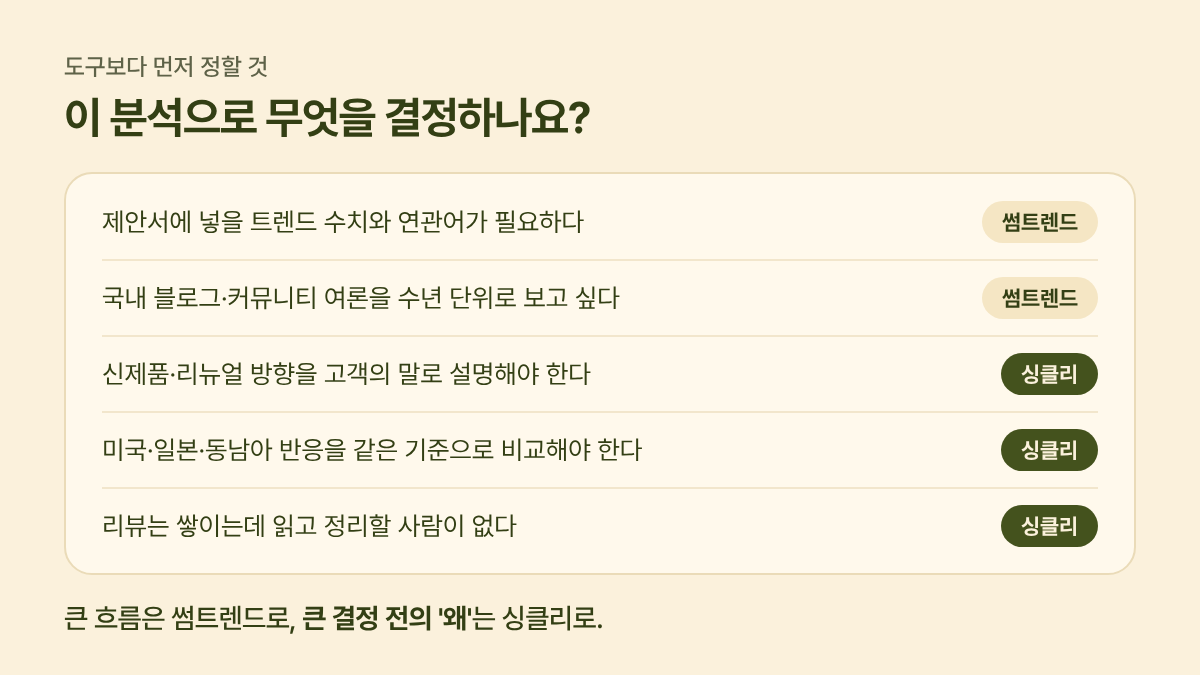
Teams that fit Sometrend
- You need trend figures and associated words for a proposal or planning doc, without much fuss
- You want to look at Korean blog and community sentiment over multiple years
- You have the time and people to do the analysis yourselves
- Your budget is in the range of tens to hundreds of thousands of won per month
Teams that fit Syncly
- Beauty or consumer-goods brands whose product reviews show up heavily on TikTok, Reels, and Shorts
- You need evidence for high-stakes decisions like new product direction, a renewal, or a competitive response
- You have to compare reactions across multiple countries (US, Japan, Southeast Asia, etc.) on the same basis
- Reviews keep piling up but nobody has time to read and organize them, so you want to outsource the analysis itself
There's also the option of using both. Keep an eye on the big picture and mention volume with Sometrend day to day, then ask Syncly "why" ahead of a big decision like a new product launch or quarterly strategy. For many teams this may be the most realistic combination.
Alpaca's takeaway: decide the question before the tool
There's no fixed answer to whether Sometrend or Syncly is better. If you're curious about mention volume, open Sometrend first. With a free plan and a 7-day trial, there's nothing to lose.
If you want to know why customers say what they say and what you should change as a result, I'd recommend a Syncly demo. Rather than starting with a quote, it's faster to look at your own brand's data first and then judge.
🦙 That was Researcher Alpaca's research notes. If anything is wrong or you'd like to know more, let me know through 'Contact Josh' below. I'll reflect it in the next round of research.
Related reading
- Social listening costs: 6 reasons prices differ from vendor to vendor
- Competitor analysis: what you miss when you only look at revenue and ads
Sources
- Sometrend plan overview — pricing by plan, data sources, periods
- Sometrend Us — analysis features, data accumulated since 2008
- VentureSquare: Sometrend enters the ChatGPT app store (May 2026) — ChatGPT and Claude connection
- VentureSquare: Sometrend MCP paid plan officially launches (July 2026) — Beauty MCP, Instagram and TikTok data from 120+ countries
- Syncly homepage (Korean) — client logos, customer testimonials, service structure
- Syncly Research Partners — timelines, deliverables, cost-saving figures
- Syncly English homepage — video social listening, MCP connection
- Syncly Pricing — social listening via sales inquiry
- LG Electronics case study (Syncly blog)


