

"Let's run some market research before the new product launches. How much does it cost?" The reason this question is hard to answer on the spot is simple. Market research isn't one product. It's several products, each priced by a different formula.
The short version
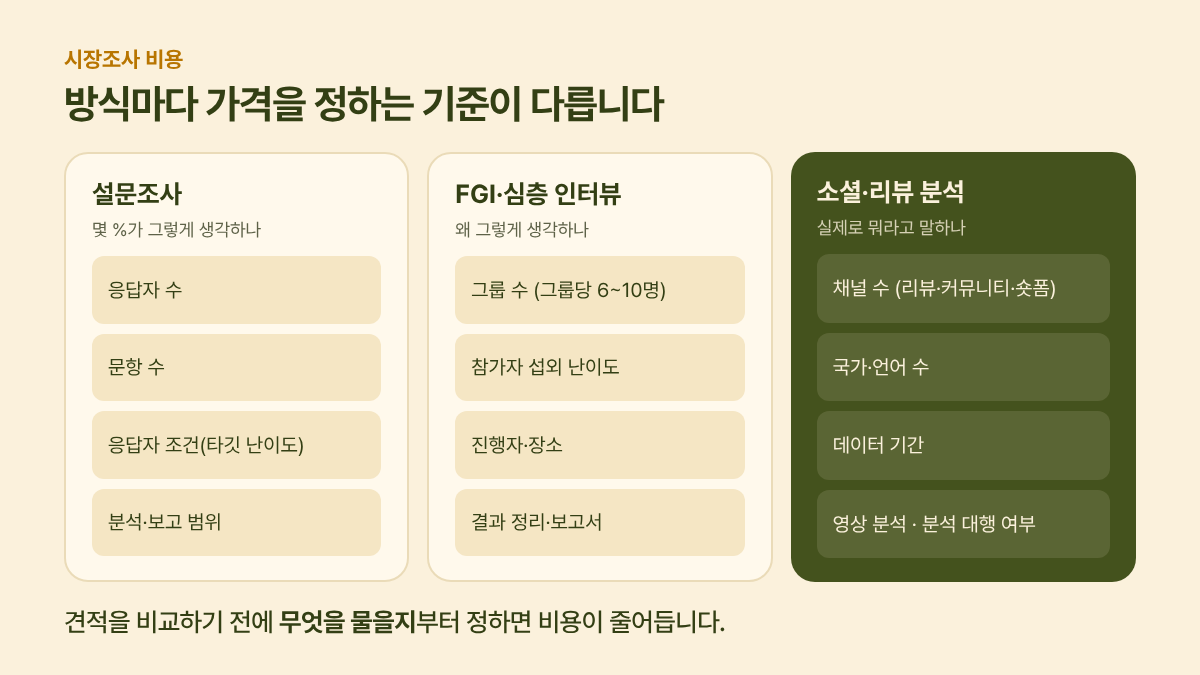
What determines the cost of market research depends on the method.
- Surveys: number of respondents × number of questions × how hard the target is to reach, plus the scope of analysis and reporting
- Focus groups and in-depth interviews: number of groups × recruiting difficulty, plus the moderator, venue, and report
- Social and review analysis: number of channels × number of countries and languages × time range, plus whether you outsource the analysis
So before you compare quotes, you have to decide what you want to learn. Once the question is set, the right method follows, and once the method is set, you can see the cost range.
1. Surveys: respondents and questions
Surveys have the most transparent pricing. For example, Opensurvey (a Korean survey platform) publishes rates for consumer panel surveys of up to 19 questions: 150,000 won for 100 respondents and 1.5 million won for 1,000 respondents (VAT excluded), and 500 won per response for surveys of five questions or fewer. They say 1,000 responses come in within about three hours on average (Opensurvey blog, July 2026).
Costs rise at three points.
- When the target is narrow: the more conditions you add, like "women in their 30s who bought a derma cosmetics product in the last three months," the harder respondents are to find and the higher the unit price.
- When the questionnaire is long: more questions means a higher unit price and lower response quality.
- When you outsource analysis and reporting: getting frequency tables alone and getting segment comparisons, strategic recommendations, and a presentation are two different quotes.
Platforms that connect you with small vendors list online survey services (sample of 100~500) at around 1.5~3 million won and analysis-and-report packages at around 800,000~2 million won (Miso blog). Brand studies from large research firms involve a much broader design and reporting scope, so they can run far higher.
2. Focus groups and in-depth interviews: number of groups and recruiting
A focus group interview (FGI) typically gathers 6~10 people per group, led by one moderator. It runs through four stages, design → participant recruiting → sessions → write-up, and takes more time and money than a survey (Opensurvey's FGI process).
The cost comes down to how many groups you run and how hard the participants are to find. Split by age bracket with just two groups each, and you're quickly at four or five groups. Participant incentives, the moderator, the venue (or online tool), transcription, and report writing all scale with the number of groups. The platform mentioned above lists qualitative research at around 1.5~3.5 million won, but the range swings widely with the number of groups and the target.
3. Social and review analysis: channels, countries, time range, and who does the analysis
Social and review analysis doesn't recruit new people. It collects and analyzes what customers have already said. So the cost is set by the scope of the data, not by respondent count.
- Channels: text from blogs and communities only, or also e-commerce reviews and what's said in TikTok and Reels videos
- Countries and languages: Korea only, or several overseas markets viewed side by side on the same criteria
- Time range: the last three months, or trends over the past 2~3 years
- Who analyzes: you subscribe to a tool and do the analysis yourselves, or you hand off everything from question definition to the report
Tool subscriptions range widely, from tens of thousands of won a month to tens of millions of won a year, and I broke down that gap separately in Social listening costs. Outsourced analysis is usually quoted per project. On its Research Partners page, Syncly says it delivers a first report within an average of 1.5 weeks versus the two months traditional research takes on average, at 40~70% lower cost. Those are the company's own figures, and the basis for comparison isn't published (Syncly Research Partners).
Methods side by side
| Surveys | Focus groups and in-depth interviews | Social and review analysis | |
|---|---|---|---|
| The question it answers | What percentage think this way | Why they think this way (depth) | What they actually say (breadth) |
| Cost unit | Respondents × questions | Number of groups | Channels, countries, time range + analysis scope |
| Time it takes | Hours to days for data collection | Weeks, starting with recruiting | Instant with a tool, weeks when outsourced |
| Best for | Concept preference, awareness measurement | Purchase motivations, uncovering hidden complaints | Renewal priorities, reactions to competing products, overseas reactions |
| Weak spot | Answers outside the options never surface | Small samples are hard to generalize | Customers who don't speak up are invisible |
4 ways to bring the quote down
- Narrow it to a single question. "Overall beauty perceptions among Gen MZ" is slower, pricier, and less useful than "In the renewal, should we change the scent or the size first?"
- Combine methods in sequence. Build hypotheses first from what customers have already said (social and reviews), then verify only those hypotheses with a survey. You'll need fewer questions and fewer groups. I covered this sequence in detail in Surveys vs. social listening.
- Get an itemized quote. When design, collection, analysis, and reporting are quoted separately, you can pick only what you really need.
- Get the raw data. With the raw data in hand, you won't have to buy everything again when you revisit the same criteria next quarter. I listed what to check before signing in How to choose a research firm.
Alpaca's takeaway
Before you ask what market research costs, answer "What will this research decide?" in one sentence. With that sentence, the method falls into place, and you can compare quotes on the same basis.
🦙 That's it for Researcher Alpaca's research notes. If anything's wrong or you want to know more, use 'Contact Josh' below to let me know. I'll factor it into my next round of research.
Related reading
- Social listening costs: 6 reasons pricing varies so much between vendors
- How to choose a research firm: 7 things to check before you hire one
Sources
- Consumer panel surveys of 19 questions or fewer are now faster and cheaper (Opensurvey, July 2026) — published prices by respondent and question count, collection time
- The 4 stages of the FGI process (Opensurvey, Dec. 2024) — participants per group, stages
- Research and survey outsourcing costs (Miso blog) — cost ranges by type of small-vendor service
- Syncly Research Partners — timeline and cost versus traditional research (company-provided figures)


