

In 2025, Korean cosmetics exports reached $11.4 billion, up 12.3% from the previous year, and the number of destination countries grew by 30 to 202. The US ($2.2 billion) overtook China ($2.0 billion), the long-time leader, to take the top spot (Cosmorning, citing the Ministry of Food and Drug Safety). Looking at the numbers alone, it seems like you could go anywhere. But the stories from brands that have actually expanded are a little different: getting in is easier than continuing to sell.
The short version
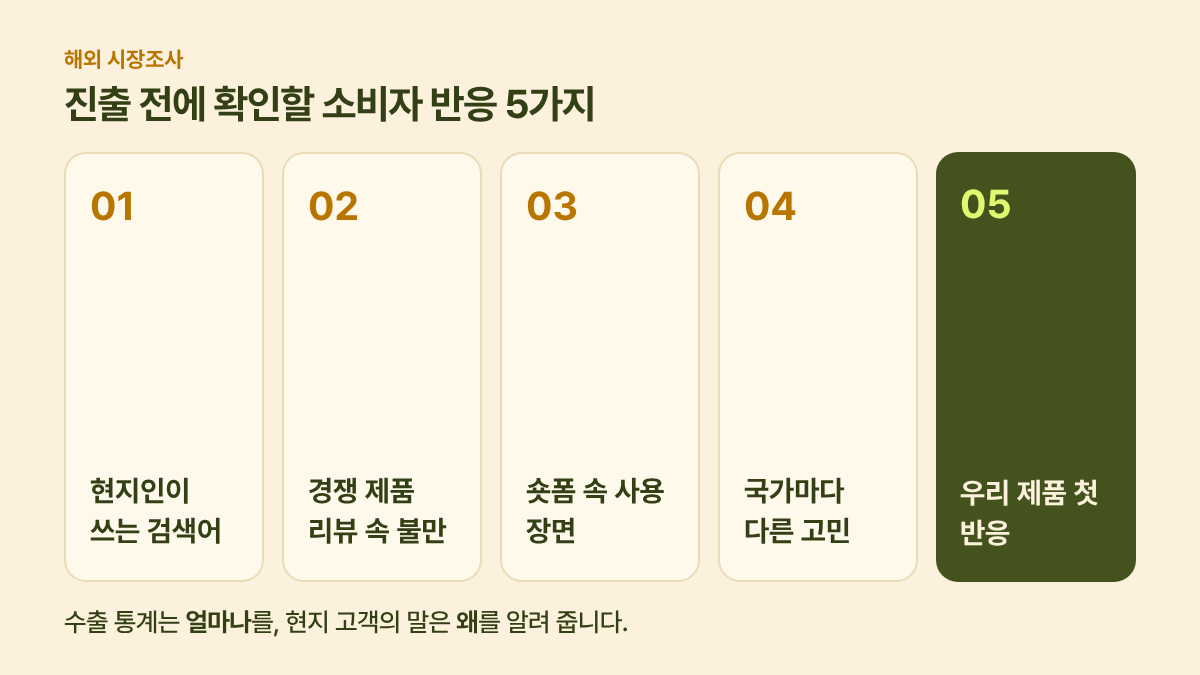
Overseas market research means using export statistics to pick "where" and using local customers' words to decide "how." Before you expand, check at least these five things: the search terms locals use, the complaints in competitor reviews, usage scenes in short-form video, the concerns that differ by country, and the first reactions to your product right after launch.
1. The search terms locals use
The same product goes by different names in different countries. At the K-Beauty Summit in September 2026, one brand CEO described using Amazon not as a sales channel but as an "experiment channel" to learn how US consumers search. By switching to the words Americans use, "serum" instead of "tonic," "hair regrowth" instead of "hair loss," monthly sales grew from roughly $1,000 to roughly $100,000 within 3~6 months (VentureSquare).
- Free: compare candidate terms in Google Trends while switching countries, and check Amazon's search autocomplete.
- Paid: use a tool like Listening Mind that provides US and Japanese search data to see the full search path.
2. Complaints in competitor reviews
Reviews of competing products already selling in the market are the cheapest market research there is. The brand above also said it read about 300 competitor reviews and reworked its product detail page. The 3- and 4-star reviews are where "good, but..." comments cluster most. I covered how to read them in 3 ways to analyze reviews.
3. Usage scenes in short-form video
Overseas customers show you where and how they use a product through short-form video. At the same event, Syncly presented an analysis of about 18,000 X posts and Qoo10 reviews for a Japanese brand, finding that videos of sunscreen being used in cars or outdoors drew roughly twice the views and engagement of indoor videos (company presentation). That's the kind of information that changes the background of your ad creative.
- Free: browse popular hashtags and videos by country in TikTok Creative Center.
- Paid: use a tool that reads what's said inside videos to collect videos that mention your category in speech alone, with no hashtag (see The limits of hashtag analysis).
4. Concerns that differ by country
Even for the same moisturizer, "long-lasting hydration" comes up first in dry regions and "stickiness" comes up first in hot, humid ones. Seasons differ too. Sort reviews and short-form video by country using the same set of attributes (hydration, stickiness, scent, price, and so on) and lay them side by side, and you'll see how to adjust your message for each market. Amazon's 2026 Prime Day analysis also noted that K-beauty sales are spreading beyond the US to Europe, Australia, and Japan, which makes country-by-country differences even more important (Hankyung Business).
5. First reactions to your product right after launch
Research doesn't end at launch. Look at the reviews and short-form reactions from the first four weeks using the same criteria as before launch, and you'll know what to fix right away. One analysis presented at the event found that on TikTok Shop in the US, 30~80% of sales for the top 20 products came from the top five videos (VentureSquare). Knowing quickly which video worked and what customers responded to in it becomes the basis for making the next one.
A free sequence to start with
- Use Google Trends (by country) to pick candidate countries and terms.
- Read 100 competitor reviews on that country's Amazon or Qoo10.
- Watch the 20 most popular videos for that country in TikTok Creative Center.
- Put all three on a single page and settle on "the one complaint we can win on."
That's enough for a first basis for deciding whether to expand. Consider tools or an outside firm when you need to compare several countries on the same criteria or track post-launch reactions every month.
Alpaca's takeaway
Export statistics tell you where the door is open; local customers' words tell you how to walk through it. If you're choosing your next market, start this week by reading 100 competitor reviews from that country.
🦙 That's it for Researcher Alpaca's research notes. If anything's wrong or you want to know more, use 'Contact Josh' below to let me know. I'll factor it into my next round of research.
Related reading
- Trend analysis sites worth trying: search volume tools and customer voice tools
- Competitor analysis: what you miss when you only look at sales and ads
Sources
- MFDS analysis of Korea's 2025 cosmetics export performance (Cosmorning, Jan. 2026) — export value, number of countries, country rankings
- K-Beauty Summit 2026 (VentureSquare, Sept. 2026) — Amazon search term case, TikTok Shop video concentration, Japanese sunscreen analysis
- Amazon announces K-beauty trends (Hankyung Business, Aug. 2026) — K-beauty market expansion based on Prime Day


