

You put three new product concepts in front of a survey panel, and concept B comes out on top. Then after launch, you read the reviews, and what customers really wanted was a "refill," which wasn't in any of the three. The survey wasn't wrong. A survey can only answer within the options we chose.
The short version
- A survey is research that asks. It tells you, with representativeness, what percentage of people think a certain way about the questions we defined.
- Social listening is research that listens. It finds complaints and expressions we didn't know about in what customers wrote on their own in reviews, communities, and short-form video.
For new product planning, rather than choosing one of the two, the sequence of listen first, then ask fails less often. Use the listening research to build your questions and answer options, and the asking research to measure how big they are.
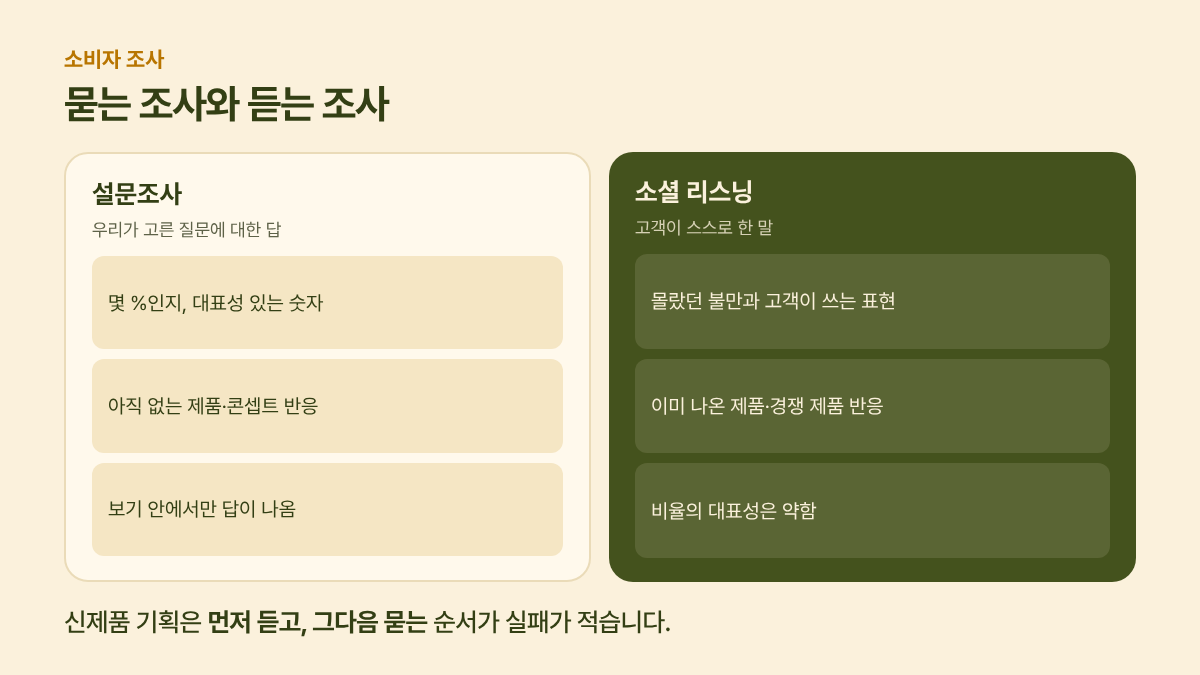
Side by side
| Survey | Social listening | |
|---|---|---|
| Data | Responses to questions | What customers already wrote |
| Strengths | Representative percentages; reactions to products and concepts that don't exist yet | Complaints you didn't know about, customers' own wording, comparison with competing products |
| Weaknesses | No answers outside the options; respondents tend to give the "good" answer | You only see the people who speak up; percentages aren't very representative |
| Time | Panel surveys collect responses in hours to days | Tools are instant; analysis services take weeks |
| Cost unit | Number of respondents × number of questions | Channels, countries, period + scope of analysis |
Panel surveys have gotten faster and cheaper than you might think. Opensurvey (a Korean online survey panel) publicly prices a survey of up to 19 questions at 1.5 million won (excl. VAT) for 1,000 respondents, and says 1,000 responses come in within about three hours on average (Opensurvey blog). So the real issue isn't cost but what to ask.
When a survey is the right fit
- When you're asking about something that doesn't exist yet. New concepts, price points, packaging mockups: things customers can't talk about yet have to be shown and asked about.
- When you have to persuade with numbers. For a report that needs a representative figure like "62% of the target prefers concept A," a survey is the right tool.
- When the customers who don't speak up matter. The quiet majority who never leave reviews, and the people who haven't tried your product yet, don't show up on social.
When social listening is the right fit
- When you don't know what to ask. If you build a survey without knowing what customers in the category are unhappy about, the options just confirm your own hypotheses.
- When you need the customer's language. Between "not sticky" and "absorbs fast," the words customers actually use should become your ad copy and your survey options.
- When you're comparing against competing products. Competitor reviews and short-form videos contain what customers said when weighing the two products side by side (see competitor analysis).
- When you're looking at overseas reactions. Before recruiting a panel in each country, you can get a first read from what customers there have already written.
Listen first, then ask: 4 steps
- Listen: Break customers' praise and complaints about your product and competing products down by attribute, from reviews, communities, and short-form video (see the VOC analysis report template).
- Form hypotheses: Pick two or three complaints that come up often and have grown recently as your hypotheses. For example: "Complaints about price relative to quantity are increasing," "There's demand for refills."
- Ask: Confirm only the hypotheses with a survey. Build the answer options from the expressions customers actually used. Fewer questions means lower cost, too.
- Listen again: After launch, look at reviews and short-form reactions again using the same criteria. Check whether the hypotheses held up and whether new complaints have appeared.
The advantage of this sequence is that the survey ends up including the options we would have missed. In the refill example above, you'd have discovered the refill demand in step 1 and measured its size in step 3.
Three common mistakes
- Reporting percentages from social data. "30% of reviews complain about the scent" means 30% of the people who left reviews. Don't report it as 30% of all customers.
- Writing survey options in the conference room. If the options are written in our language, customers just pick whichever is closest.
- Doing it once and stopping. If you only research before launch and never look at post-launch reactions with the same criteria, you can't learn what you got right.
Alpaca's takeaway
Surveys and social listening aren't competing methods; they're methods with an order. For your next new product research, read what customers have already written before you write a single survey question. The options change, and so do the results.
🦙 That's it for Researcher Alpaca's research notes. If anything's wrong or you have more questions, let me know through "Contact Josh" below. I'll fold it into the next one.
Related posts
- Market research cost: why surveys, interviews, and social analysis are priced so differently
- VOC analysis report: how to write one that leads to decisions, with a template
Sources
- Consumer panel surveys of 19 questions or fewer are now faster and cheaper (Opensurvey, July 2026) — published panel survey pricing, collection time
- Syncly Research Partners — review collection, topic classification, strength/risk identification process


