

Get a couple of social listening quotes and you'll be confused. One vendor says tens of thousands of won a month; another says tens of millions of won a year. It's all "social listening," so why the gap?
The short version
Judging by published prices alone, social listening costs range from tens of thousands of won a month to tens of millions of won a year or more. What makes the difference is the scope of the data, the countries, the volume, the number of users, the contract length, and, most of all, who does the analysis. Buy only the tool and you pay for analysis with your team's time; outsource it and you're buying that time with money.
The market, by published prices
The vendors that publish price lists are mostly self-serve tools that practitioners use themselves. The closer you get to enterprise, the more pricing turns into "contact sales." Figures are as of the second half of 2026.
| Service | Published price | What it is |
|---|---|---|
| Sometrend Basic | 29,700 won/month | Korean blogs, news, and Instagram, self-serve |
| Sometrend Premium | 149,000 won/month | Adds communities and YouTube, Excel export |
| Sometrend Business (Cloud) | Contact sales | For enterprises |
| Hootsuite Listening | From $99/month | Listening feature of an overseas social management tool, advanced features are enterprise-only |
| Sprout Social | $199~399 per seat/month + listening add-on of roughly $999/month | Scales with user count |
| Brandwatch · Meltwater | Not published (generally reported at $1,000+/month) | Enterprise quote |
| Sprinklr | $25,000+/year | Enterprise quote |
| Syncly | Not published (social listening is contact-sales) | Video analysis + outsourced analysis available |
Overseas tool prices are based on Swydo's May 2026 roundup and a G2 comparison, and they vary with exchange rates and contract terms. The further down the table you go, the more the tool does, and the less work is left for your team.
The 6 factors that drive the price
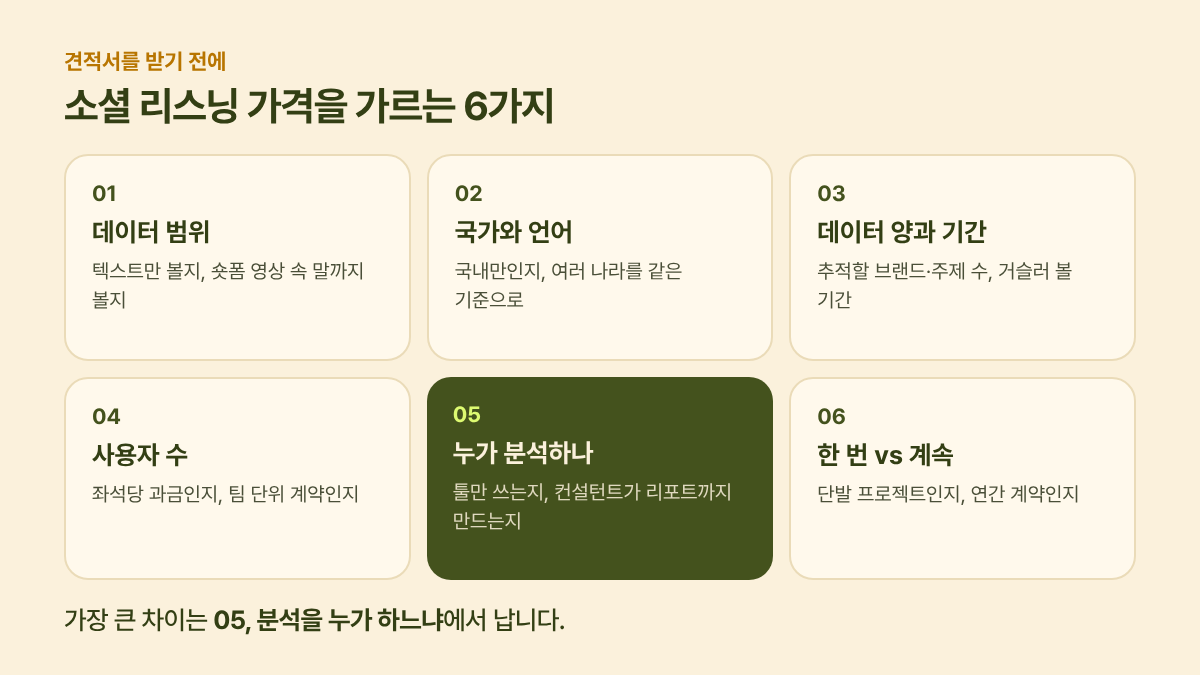
- Data scope. It depends on whether you're looking at text alone, like blogs and news, or also at what's said inside TikTok, Reels, and Shorts videos. Sometrend's plans also step up as you add channels. Video requires transcribing audio and parsing the screen, so it costs more than text.
- Countries and languages. Looking at Korea alone is a different job from viewing the US, Japan, and Southeast Asia side by side on the same criteria. Each language needs its own collection and noise filtering.
- Data volume and time range. The more brands and topics you track, and the further back you look, the higher the price. Overseas tools often tier their plans by number of topics or data retention period.
- Number of users. With per-seat pricing like Sprout Social's, every new team member adds to the bill. Check first whether the contract is team-based.
- Who does the analysis. This is where the biggest gap comes from. A tool subscription shows you data; an analysis service handles question definition, keyword design, interpretation, and the report. Syncly Research Partners, for example, assigns a dedicated consultant who delivers a final report within an average of four weeks.
- One-off or ongoing. A one-time project for a single new product and an annual contract are structured differently. The more often you repeat, the lower the per-run cost tends to be.
Costs that don't show up on the quote
A cheap-looking quote rarely stays cheap. There are costs that fall outside the price list.
- Your team's time: designing keywords, filtering out noise like ads and namesakes, reading the original posts, and turning it all into a report. The real price of a self-serve tool is the subscription plus this time.
- Add-on modules: it's common for the listening feature itself to be a separate add-on, or for advanced features to live only in higher plans.
- Raw data: some vendors hand over only the report and keep the raw data, or charge extra for it. Without the raw data, you buy everything again when you redo the same comparison next quarter.
- Minimum contract term: enterprise tools often default to annual contracts. Make sure you're not paying for a year to run an analysis you need once.
What to sort out before asking for a quote
- The one decision this analysis will inform (e.g., the direction of the next renewal)
- The channels to look at (text only / including short-form video / including e-commerce reviews)
- Countries and time range (e.g., Korea and the US, last 12 months)
- 2~3 competing brands to compare
- One-off, or repeated every quarter
- How much time your team can put into analysis (hours per week)
- The deliverable you want (dashboard / report / raw data)
Walk in with these seven items and you can get quotes from any vendor on the same basis, which makes comparing them easy.
Alpaca's takeaway: what to look at before price
If all you need is mention volume and trends, a self-serve tool at tens of thousands of won a month is plenty. There's no reason to buy an expensive one. But if the decision carries real weight, like a new product direction or an overseas expansion, and nobody on your team has time to analyze, put "the cost of outsourcing the analysis" and "the cost of doing it ourselves" side by side and compare.
Syncly doesn't publish prices and quotes each brand individually. If you bring the checklist above to a demo, you can see results on your own brand's data first and then judge whether the cost is worth it.
🦙 That's it for Researcher Alpaca's research notes. If anything's wrong or you want to know more, use 'Contact Josh' below to let me know. I'll factor it into my next round of research.
Related reading
- Competitor analysis: what you miss when you only look at sales and ads
- Sometrend vs. Syncly: which one fits your brand?
Sources
- Sometrend plans — prices and channels by plan
- Swydo: 17 Best Social Listening Tools for Marketing Agencies (updated May 15, 2026) — overseas tool pricing and billing models
- G2: Best Social Media Listening Tools (Apr. 2026) — Sprout Social and Hootsuite starting prices
- Syncly Pricing — social listening is contact-sales
- Syncly Research Partners — timeline and deliverables


