

"Can you put together a competitor analysis?" When you hear this, you usually start by gathering competitors' revenue, price lists, and the ads they're running right now. The slides fill up fast, but there's no answer to the question that always comes up in the meeting: "So why do customers buy theirs?"
The short version
The most useful competitor analysis for a brand marketer is putting the words customers use to praise and complain about competitors' products side by side with your own. Revenue and ads are results; the reasons are in reviews, social media, and these days in what people say in short-form videos. This post breaks that analysis into five steps and gives you a template you can use right away.
Competitor analysis has three layers
The three layers answer different questions. If a report feels thin, it's usually the third layer that's missing.
| Layer | Question it answers | Where to look | Limitation |
|---|---|---|---|
| Market and revenue | How much are they selling, and how much have they grown? | Public filings and audit reports, market reports, e-commerce rankings | Shows only results, not reasons |
| Marketing activity | What are they communicating, and how? | Meta Ad Library, official accounts, collaboration content, mention-volume tools | Only what the brand says, not what customers took away |
| Customer perception | Why do customers buy, and why do they leave? | E-commerce reviews, communities, TikTok/Reels/Shorts reviews | High volume and scattered, so reading takes time |
Put marketing activity next to customer perception and something interesting shows up. If a competitor leads with "gentle on skin" but customers talk more about "scent," that gap is where you can step in. In one real case, a brand manager said social virality was concentrated on blackhead removal while actual reviews clustered around residue and breakout concerns, so they overhauled their sampling strategy entirely (Syncly customer story).
Competitor analysis in customers' words: 5 steps
- Start with the question you need to decide. Not "analyze the competitors," but one narrow question like "Should we change the formula in the next renewal?" or "Can we raise the price?" Without a question, data piles up endlessly and no conclusion ever arrives.
- Two or three competitors, same time period. Pick the products customers actually weigh against yours. The real competitor isn't the revenue leader; it's "the product that shows up alongside yours in comparison reviews."
- Collect where customers talk. E-commerce reviews, community posts, and TikTok/Reels/Shorts reviews. In beauty and consumer goods, skipping video reviews means missing a big chunk of today's customer voice. Videos often mention products in speech only, with no hashtags at all.
- Break it down by attribute, not star rating. A review saying "love the scent, but there's not much of it" isn't one 4-star review; it's two statements: scent (+) and quantity (−). Define attributes that fit your category, like feel, efficacy, scent, price, packaging, and shipping, and count praise and complaints for each one.
- Report with the original quotes. Put two or three lines of customers' words next to "we get more formula complaints than the competitor," and even if the CEO doubts the numbers, the conversation keeps going.
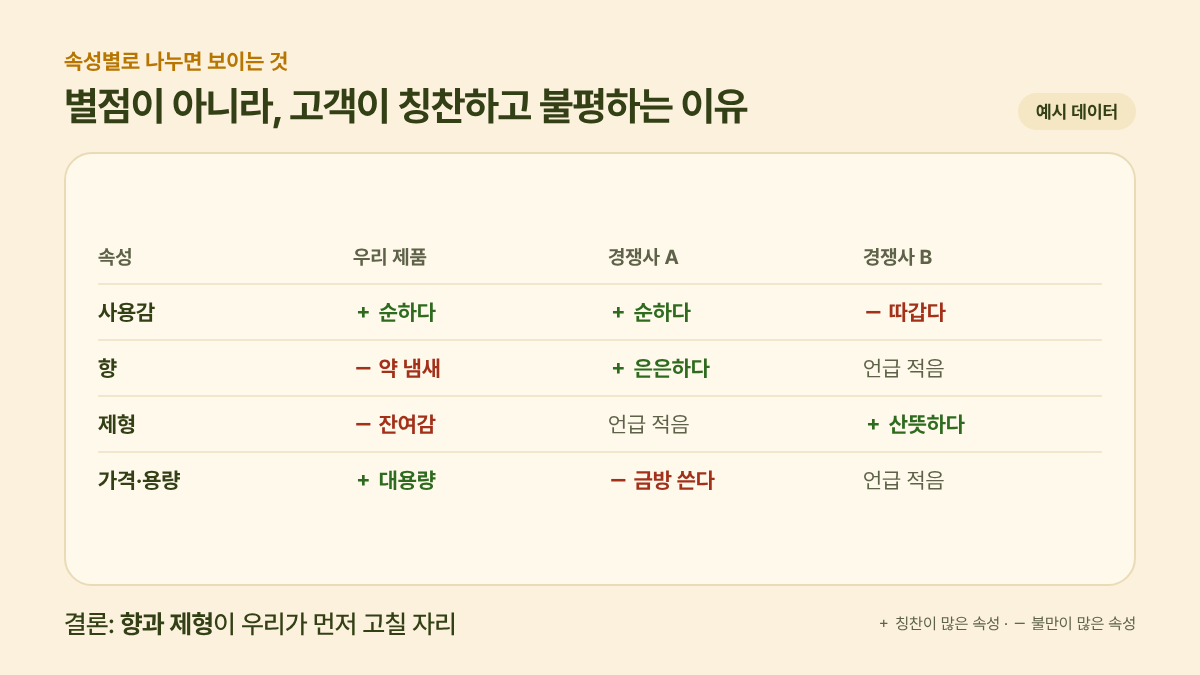
Ready-to-use template. Copy the blanks straight into Excel. In each cell, enter the praise and complaint counts and one representative quote.
| Attribute | Our product | Competitor A | Competitor B | Interpretation |
|---|---|---|---|---|
| Feel | Praise ○ / Complaints ○ · "quote" | |||
| Efficacy | ||||
| Scent, taste, design | ||||
| Price and quantity | ||||
| Packaging and shipping | ||||
| Conclusion: the gap we can fill |
Where you get stuck doing it yourself
The method is simple, but when you try it, you stall in three places.
- Volume: Reviews from just three competitors add up to thousands. Reading a sample of 200 is fast, but the conclusion changes depending on which 200 you picked.
- Video: TikTok and Reels reviews are hard to find exhaustively through search, and once found, you have to watch each one and transcribe it by hand.
- Countries: To cover overseas markets as well, you have to redo it for each language, and aligning the criteria is hard.
So the options split depending on your team's situation.
| Approach | When it fits | Watch out for |
|---|---|---|
| Excel by hand | A few hundred reviews, one or two Korean channels | Takes the most of the owner's time |
| Pasting reviews into an AI like ChatGPT | When you just need a quick sense of direction | Sees only the reviews you pasted; hard to trace back to originals or reproduce |
| Mention-volume tools (Sometrend, etc.) | Who's talked about more, comparing associated keywords | You still have to read for praise and complaints by attribute yourself |
| Analysis service (Syncly Research Partners, etc.) | When the decision is big and you need video and overseas coverage | Costs money and needs a design period before starting |
If you go with a service, make sure you get the raw data handed over. If all you're left with is a report, you can't run the same comparison again next quarter. Syncly Research Partners covers social and reviews plus what's said in videos, lays out your strengths and weaknesses against competitors, and hands over all the raw data.
Alpaca's takeaway
The goal of competitor analysis isn't to know your competitors better; it's to decide what you will change. That's why customers' words outlast the numbers, and the one decision that comes out of those words outlasts the words. This week, try filling in just one attribute in the template above.
If you're considering outsourcing the analysis, these posts should help.
- Social listening cost: 6 reasons prices vary by vendor
- Sometrend vs. Syncly: which is right for your brand?
If you want to see actual results for your brand and two or three competitors, list the brands you'd like to compare when you request a Syncly demo.
🦙 That's it for Researcher Alpaca's research notes. If anything's wrong or you have more questions, let me know through "Contact Josh" below. I'll fold it into the next one.
Sources
- Syncly Research Partners — customer story (blackhead/residue case), raw data delivery
- LG Electronics case (Syncly blog) — attribute-based analysis that splits sentences into units of meaning to read sentiment
- Sometrend plans — data coverage of mention-volume and associated-keyword tools


