

When someone says "let's bring in a consumer data tool," Listening Mind and Sometrend often come up together as candidates. But the two tools differ right from the data they look at. Add Syncly, which looks at what people say in videos, and the criteria for choosing become even clearer.
The bottom line
- Listening Mind uses search data to show what people look for and worry about before buying.
- Sometrend uses mentions on blogs, communities, and Instagram to show how much, and alongside which words, people talk about something.
- Syncly uses audio and visuals from TikTok, Reels, and Shorts videos to show what people who've tried the product say while showing it.
It's not about which of the three is better. Choose based on which stage the question you need to answer right now belongs to.
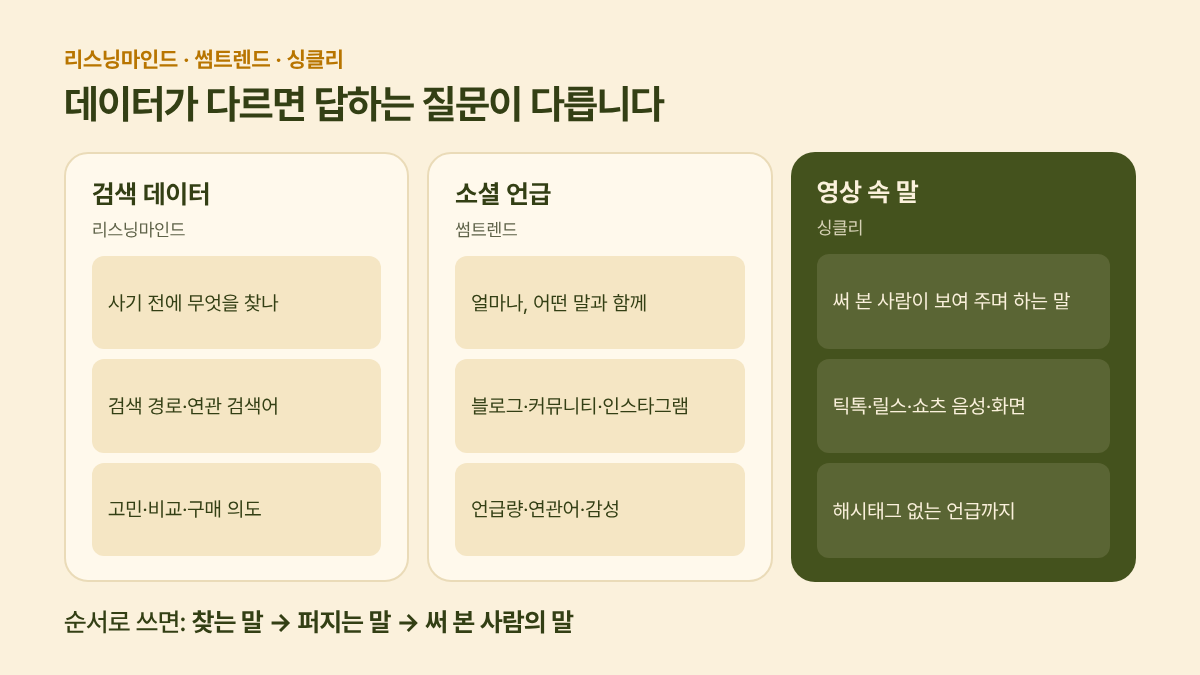
Side-by-side comparison
| Item | Listening Mind | Sometrend | Syncly |
|---|---|---|---|
| Data | Search terms, search volume, related searches, search paths | Mentions on blogs, news, Instagram, communities, YouTube, and cafes (NAVER's community forums) | Audio and visuals from TikTok, Reels, and Shorts videos; first-party data such as e-commerce reviews and support tickets |
| Question answered | What do people search for, and in what order do they compare? | How much, with what, and with what emotion do people talk about it? | What do people who've tried it praise, and what do they complain about? |
| Countries | Korea, Japan, US | Korea-focused; for beauty, Instagram and TikTok across some 120 countries | Per-country analysis |
| AI connectivity | MCP, API | MCP, ChatGPT app | Remote MCP, natural-language questions |
| Public pricing | Not found in public sources | Free; Basic 29,700 won/month; Premium 149,000 won/month | Not disclosed (contact sales) |
| Publicly named customers | Cheil Worldwide, HS Ad, Innocean, LG Electronics, CJ CheilJedang, and others | Anyone, via public plans | Korean and international beauty and food brands, LG Electronics, and others |
Sources: for Listening Mind, Byline Network and Digital Insight; for Sometrend, the Sometrend plan page and VentureSquare; for Syncly, Syncly and the Syncly Korea website.
Listening Mind: it sees the deliberation before the purchase
Listening Mind is a search data analysis service built by Ascent Korea. Enter a keyword and it groups related searches by topic and shows which search terms people go through and where they end up (search paths).
- What it's good at: Purchase journeys, what triggers entry into a category, and the points of comparison against competing brands. It feeds directly into ad keyword and message design.
- Where it's weak: Search is a 'before buying' question, so post-purchase satisfaction and complaints are hard to see. Things people talk about only in videos, without searching, aren't in the data either.
Sometrend: it sees the words that spread
Sometrend is a social big data service run by VAIV Company. With Korean data accumulated since 2008, you can self-serve mention volume trends, associated words, and positive/negative sentiment. In 2026 it also became usable inside AI chat windows through MCP and a Beauty MCP (see Sometrend MCP explained).
- What it's good at: Low cost of entry, long time series, and the breadth of Korean text channels.
- Where it's weak: The 'why' behind the mention volume requires reading the original posts yourself, and whether it reads what's said inside videos hasn't been disclosed. In the end, the analysis is done by the person in charge.
Syncly: it sees what people who've tried it say
Syncly is video-first social listening. It transcribes the audio of TikTok, Reels, and Shorts videos (STT), reads the products and text on screen (AI Vision), and captures mentions made only in speech, without hashtags. It also bundles internal data such as e-commerce reviews and support tickets and breaks it down by attribute.
- What it's good at: Beauty and food, where short-form reviews are plentiful; decisions that need complaints prioritized, like renewals and new products; and teams that want to hand off the analysis (Research Partners).
- Where it's weak: Pricing isn't public, so it's hard to gauge the cost before a quote. For decade-long trends on Korean blogs and cafes, or search-based purchase journeys, other tools are stronger.
Recommendations by situation
| The question you need to answer now | Tool to look at first |
|---|---|
| I need to decide on ad keywords and messaging | Listening Mind |
| I want a quick read on whether mentions of our brand have increased | Sometrend |
| I want to see Korean community sentiment over several years | Sometrend |
| I want to know how our product is actually talked about in short-form video | Syncly |
| I need to decide what to fix first in a renewal | Syncly |
| I want to see first reactions in a country we're expanding into | Syncly; for beauty, also Sometrend's Beauty MCP |
If budget allows, there's also the option of using them in sequence. Confirm the words customers search for, see how those words spread on social, and then verify the actual usage experience through reviews in videos.
Weaknesses all social listening tools share
Whichever tool you pick, some limits remain.
- Customers who don't speak up are invisible. If you need representative proportions, a survey is the right call (see Surveys vs social listening).
- Collection scope determines the results. Depending on which channels and languages were gathered, the same question yields different answers.
- You need someone to do the analysis. The more self-serve the tool, the more of the owner's time goes into keyword design and interpretation (see Social listening tool vs agency).
Alpaca's takeaway
Before choosing among the three tools, write your question down in a single line. If it's "what are customers looking for," that's search. If it's "how much are they talking," that's social. If it's "what do they say after trying it," that's video. Once the question is set, the tool almost picks itself.
🦙 That was Researcher Alpaca's research note. If anything is wrong or you'd like to know more, let me know via 'Contact Josh' below. I'll fold it into the next round of research.
Related reading
- Sometrend vs Syncly: which one fits our brand?
- Sometrend MCP: how to view social data with ChatGPT and Claude, and its limits
Sources
- Listening Mind expands global search data coverage to the US (Byline Network, July 2025) — Ascent Korea, customers, features
- Listening Mind (Digital Insight, 2026) — Korea, Japan, and US data; tool composition; MCP and API
- Sometrend plan page — public pricing
- Sometrend MCP paid billing system officially launches (VentureSquare, July 2026) — Beauty MCP
- Syncly — video analysis (STT, AI Vision), remote MCP
- Syncly Korea website — service composition, customer testimonials


