

You hire a research company, and two months later you get a thick report, but it has no answer to the decision you actually need to make in the meeting. It's more common than you'd think. Usually it's not a matter of the company's competence; the cause is not asking what you should have asked before signing the contract.
The short version
You'll fail less often choosing a research company by the following seven things than by price or name recognition. In particular, make sure the contract spells out whether the deliverables include raw data and whether costs are itemized.
Research companies come in roughly three kinds
| Type | What they mainly do | Questions they suit |
|---|---|---|
| Survey and panel research companies | Survey design, panel recruitment, statistical analysis | "What percentage think that way?" |
| Qualitative research (FGI and interview) companies | Focus groups, in-depth interviews, observation | "Why do they think that way?" (a few people, in depth) |
| Social and review data analysis companies | Collecting and analyzing what customers have already said | "What are they actually saying?" (many people, broadly) |
The three aren't competitors so much as answers to different questions. Surveys answer what we ask; social and review analysis is what customers said on their own without being asked. The type of company changes depending on what the question is.
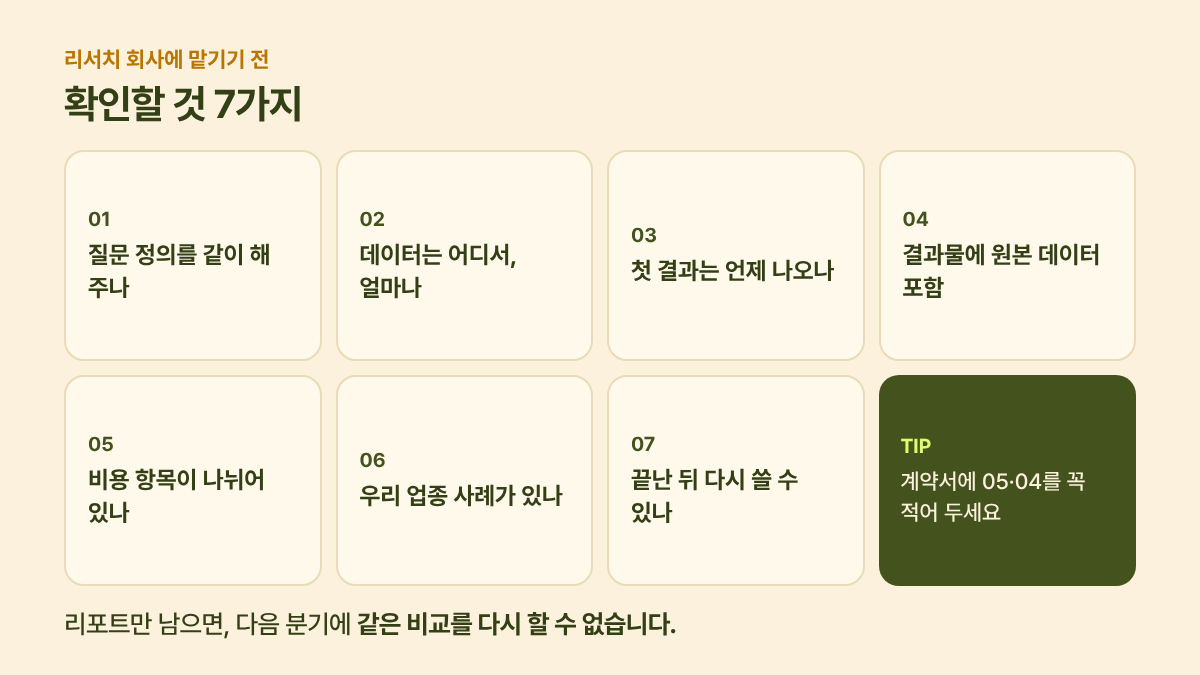
7 things to check
1. Do they help define the question? If you hand over just a topic, like "research on MZ generation beauty trends" (MZ is Korea's shorthand for millennials and Gen Z), you'll get a report about the topic. A good company asks in the first meeting, "What will you decide with this research?" and narrows the question down to a single decision. If that question never comes up, be careful.
2. Where does the data come from, and how much? For a survey, check the panel composition and sample size; for social analysis, check the channels (blogs, communities, e-commerce reviews, short-form video), countries, and time period. Especially in a category with a lot of short-form video, ask "Do you also collect mentions made only in speech within the video, without hashtags?" (see the limits of hashtag analysis).
3. When do the first results come? If you only wait for the final report, there's no chance to change direction midway. Get a schedule for when you can see interim results. For example, Syncly Research Partners says it delivers a first report within an average of 1.5 weeks and a final report within 4 weeks (per the company's own materials).
4. Do the deliverables include raw data? If you only receive a report, you can't compare again on the same basis next quarter. Check whether you can receive the raw data (raw survey responses, the list of collected posts and reviews) and whether there's an extra charge.
5. Are costs itemized? If the quote only says "research package, ₩X", it's hard to compare. Ask them to break it into design, data collection (panel or crawling), analysis, reporting, and extra meetings, and you'll see what differs between companies. I covered why costs vary separately in social listening costs.
6. Do they have experience in your industry? Beauty and B2B software differ in both the channels where customers talk and the words they use. Ask about clients or cases in the same industry. If they can't name names, hearing even "what question they answered and what they delivered" is enough.
7. Can you reuse it after it's over? Research rarely ends after a single round. Check whether the same classification scheme can be reused as is in the next round, and whether there's a dashboard where you can view the data after the project ends. Syncly says Research Partners results are available on a dashboard for 2 months.
Questions to send before signing (copy and use)
- The decision we'll make with this research is X. Can you propose a design that fits this question?
- What are the data sources (channels, countries, time period) and the expected volume?
- When will we receive interim results and the final report, respectively?
- Can we receive the raw data as well? Is there a separate charge?
- Can you break the quote down into design, collection, analysis, and reporting?
- Do you have examples of projects similar to our industry?
- How do cost and timeline change when we rerun the research on the same basis next quarter?
Do it yourself, or outsource?
If it's a few hundred reviews and one or two Korean channels, doing it in-house with Excel is enough (see the template in VOC analysis report). On the other hand, outsourcing is faster in cases like these.
- When you need to look at short-form video reviews and overseas reactions together
- When the data runs past several thousand items and is hard to classify by hand
- When the person in charge needs to spend time on decisions and execution rather than analysis
Alpaca's takeaway
Choosing a research company ultimately comes down to finding a partner who helps define the question with you and leaves you data you can use next time. If any of the seven items above has a fuzzy answer, go back and ask about that part first before signing.
🦙 That was Researcher Alpaca's research notes. If anything is wrong or you have more questions, let me know via 'Contact Josh' below. I'll reflect it in the next round of research.
Related reading
- Social listening costs: 6 reasons prices differ between vendors
- Sometrend vs. Syncly: which one fits our brand?
Sources
- Syncly Research Partners — first and final report schedule, raw data, dashboard access (company materials)


