

You buy a tool, and three months later the only person who has logged in is the one person in charge of it, and even they only log in to grab screenshots for the month-end report. That's a story you hear a lot from teams that adopted a social listening tool. It's not because the tool is bad. A tool only shows you the data; the analysis still gets done with a human's time.
The short version
- A tool subscription fits teams that need to watch brand mentions every day (crisis response, real-time campaign reactions) and have someone to own that job
- An agency fits teams that are facing one big decision, like a rebrand, a new product, or an overseas launch, and are short on people and time to do the analysis
- Using both fits teams that watch the general flow with a tool day to day, and hand one big question to an agency each quarter
The deciding factor isn't budget, it's whether you have someone to do the analysis.
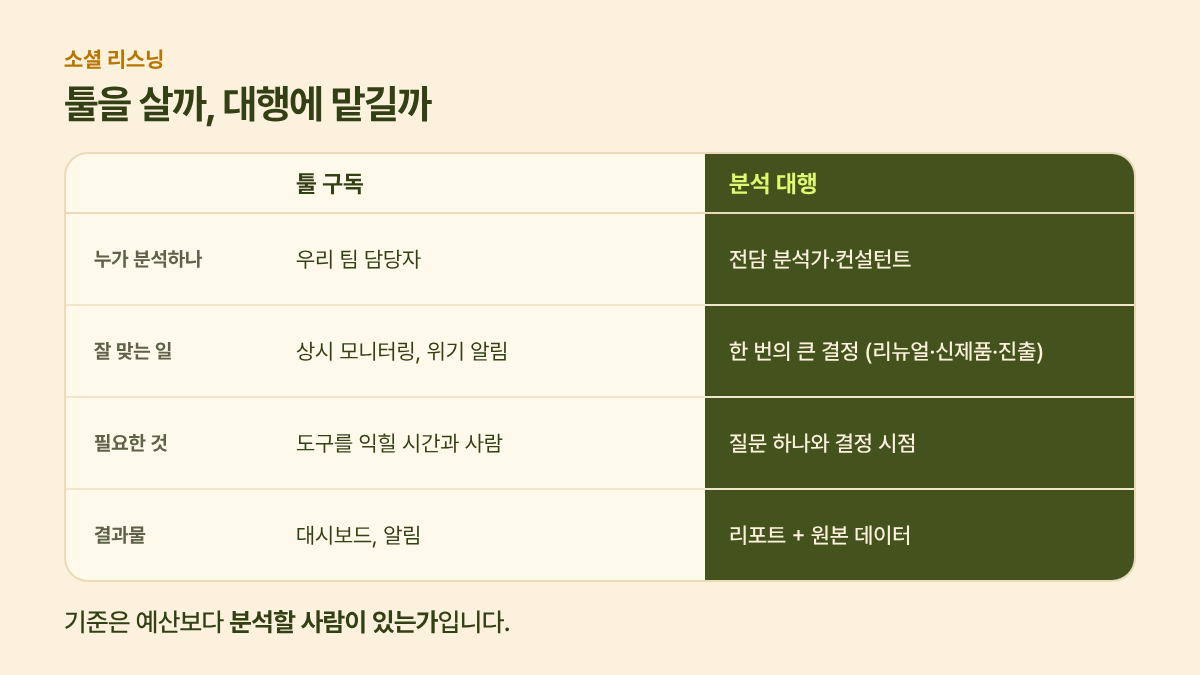
How a tool and an agency differ
| Tool subscription | Outsourced analysis | |
|---|---|---|
| Who does the analysis | Your team's owner | Dedicated analysts and consultants |
| Best suited for | Always-on monitoring, crisis alerts, real-time campaign reactions | Rebrand priorities, new product planning, competitor comparison, overseas reactions |
| Time to start | Right after signing up | A few weeks after defining the question |
| What your team has to do | Design keywords, remove noise, read raw posts, write reports | Define the question, give feedback on interim results, decide |
| Cost structure | Monthly or annual subscription (by seats, topics, channels) | Per-project quote |
| Deliverables | Dashboard, alerts, downloadable data | Report + raw data (varies by vendor) |
I covered the cost range and what drives the price separately in Social listening cost.
When a tool subscription is the right choice
- When there's something you have to watch every day. If your brand needs to know within hours when an issue blows up, you need a tool with alerts. An agency can't move at that speed.
- When the owner has time to learn the tool. The first few weeks go into keyword combinations, exclusion terms, and filtering out people with the same name. If you can spare that time, a tool is the most economical choice.
- When the questions change often. If light questions keep popping up, campaign reactions today, a competitor's new product tomorrow, a tool you can search yourself is more convenient.
If your focus is mostly Korean text channels, starting with a self-serve tool like Sometrend (a Korean social analytics tool) is a low-commitment way in (see Sometrend vs. Syncly).
When an agency is the right choice
- When you need evidence for a single decision. Facing a hard-to-reverse decision like what to change first in a rebrand, or which country to enter first, you need one analysis designed around the question, not a dashboard.
- When there's no one to do the analysis. Brand marketers usually juggle campaigns, content, and partnerships at the same time. If you don't have time to learn a tool and read thousands of reviews, an agency is how you buy that time.
- When video and overseas markets are mixed in. Comparing what's said in TikToks and Reels, or reactions across several countries, on the same yardstick is tricky with a tool alone.
For example, Syncly Research Partners assigns a dedicated consultant from question definition onward: week 1 sets the goals and data, weeks 2 to 3 are analysis, and week 4 delivers the final report and the full raw data. They say you also get dashboard access for two months afterward (Syncly Research Partners).
When an agency is the wrong choice
- When real-time crisis response is the main goal: a project measured in weeks can't respond to an issue that broke today.
- When the question hasn't been decided: if you hand it over with "there's bound to be some insight in there," all you'll end up with is a thick report. One question to decide on comes first.
- When you need representative percentages: "What percent of our target prefers X" is a question for a survey, not social data (see Surveys vs. social listening).
Diagnosing your team: 5 questions
| Question | If yes |
|---|---|
| Do you need to check brand mentions every day or every week? | Tool |
| Do you have an owner who can learn the tool and spend a few hours on it every week? | Tool |
| Is there a big decision you have to make within 3 months? | Agency |
| Are reactions in short-form video or overseas reactions important? | Agency (or a tool that can analyze video) |
| Do the results need to go straight into an executive report? | Agency |
If 'tool' and 'agency' come out roughly even, mixing the two is the better move. Watch the everyday flow with a self-serve tool and hand only the one big question per quarter to an agency, and you save both money and time.
Alpaca's takeaway
Before tool vs. agency, the first thing to decide is where you want to spend your team's time. If time spent analyzing is your team's strength, pick a tool. If time spent deciding and executing is more precious, pick an agency.
🦙 That was Researcher Alpaca's research notes. If anything is wrong or you have more questions, let me know through the 'Contact Josh' link below. I'll reflect it in the next round of research.
Related reading
- Social listening cost: 6 reasons prices differ from vendor to vendor
- Sometrend vs. Syncly: which is right for your brand?
- How to choose a research company: 7 things to check before you hire one
Sources
- Syncly Research Partners — process, deliverables, dashboard access
- Sometrend plans — self-serve tool pricing


