
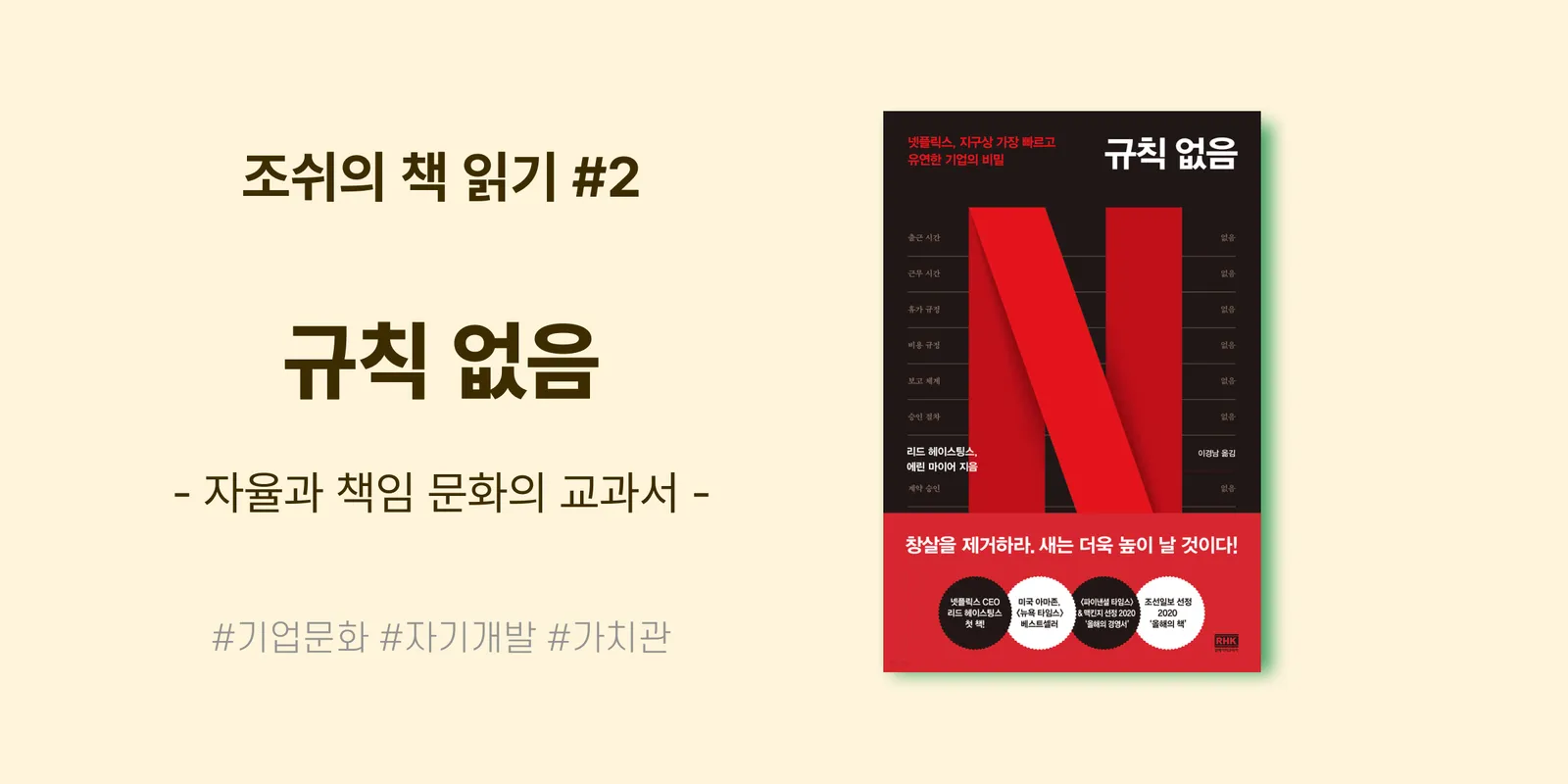
A book that gives companies the option of 'freedom and responsibility'
More and more companies are aiming for freedom and responsibility and a flat organizational culture.
Indent Corporation, where I work (a Korean review-marketing SaaS company), also offers policies that epitomize freedom and responsibility, like 'unlimited remote work and vacation.' But as this book explains, these aren't policies created simply as perks, and I don't think our team members experience them that way either.
In fact, just like the Netflix examples in the book, Indent's team members don't differ much from other companies in how much they work remotely or how much vacation they take. If anything, we've built mechanisms so that communication and work sharing stay active even when people are remote.
So why offer a company culture based on 'freedom and responsibility' at all?
Some say this book's ideas are too extreme, and especially ill-suited to Korean companies.
That's why I'd suggest that whoever picks up No Rules Rules next read the last part first.
Co-author Erin Meyer's The Culture Map gives us a hint about how we should take this book.
A fact we have to admit: 'feedback is supposed to feel bad'
Along with 'talent density,' this book stresses the importance of feedback.
It encourages feedback that goes well beyond the quiet kind we usually imagine: far more direct, and far more of it.
It even holds up as a model case someone raising a hand in the middle of a lecture to tell the speaker, in real time, 'your talk is contradictory and it's making the audience lose focus.'
Even if it stings in the moment, you later come to recognize that the feedback helped your productivity.
The 4A guidelines Netflix emphasizes for a healthy feedback culture go like this.
As How to Win Friends and Influence People puts it, we have to remember that 'nobody likes being criticized.' I used to doubt myself for feeling bad about feedback, but not anymore.
It hurts now but helps later. Feedback is like strength training.
The one rule for expenses: 'act in the company's best interest'
For about six months I worked at a company that required an enormous amount of paperwork for expense approvals and reimbursements.
One day I needed to buy a design tool for marketing. For a tool that cost less than 50,000 won a month, I had to spend about half a day on internal persuasion and approval forms. At that point, the 'work-hour efficiency' I'd written on the form as the purpose of the tool was already a lost cause.
Netflix eliminated its expense policy and let team members handle payments on their own judgment. I expected the story to go 'they only had excellent people, so nobody abused it,' but I was wrong.
There were many cases of people blowing company money for purposes and reasons more outlandish than I'd imagined. I realized this isn't simply a matter of individual morality.
At the crossroads of slowing down work with complicated expense documentation or relying on uncertain individual morality, Netflix came up with this answer.
"Act in Netflix's best interest."
A person flying first class to be in good shape for an important meeting? OK. Buying a high-end TV for a demo to an outside vendor? Also OK. But enjoying expensive wine with a contact from an outside meeting needs a second look.
It still comes down to individual judgment, of course, but I think a lot would change if people thought about that sentence once before swiping the corporate card.
'Freedom and responsibility' isn't a cure-all
If I had to name one thing I found disappointing about this book, it's that the most important content is tucked into the last part.
As many people already recognize, 'freedom and responsibility' is not a keyword you can apply to every situation. Even the authors state that not every aspect of Netflix is built on rules of 'freedom and responsibility.'
In roles that pursue creativity, 'freedom and responsibility' helps maximize speed and results. But for problems that aren't like that, process still matters far more.
For work where failure is unforgivable or safety is the first priority, like 'policies on workplace sexual harassment,' 'handling members' personal data,' or 'legal matters between employees and the company,' freedom and responsibility becomes poison.
If the products and services a company deals in lean heavily in that direction, it needs to maintain a somewhat conservative direction in shaping its culture too.
Differences between national cultures also have to be considered. Take a look at the culture map below. This isn't a picture meant to show that Korea has a 'kkondae' culture (Korean slang for condescending, old-school bosses).
It shows that only by recognizing that Korea's growth formula to date differs from Netflix's direction can we adapt it appropriately.
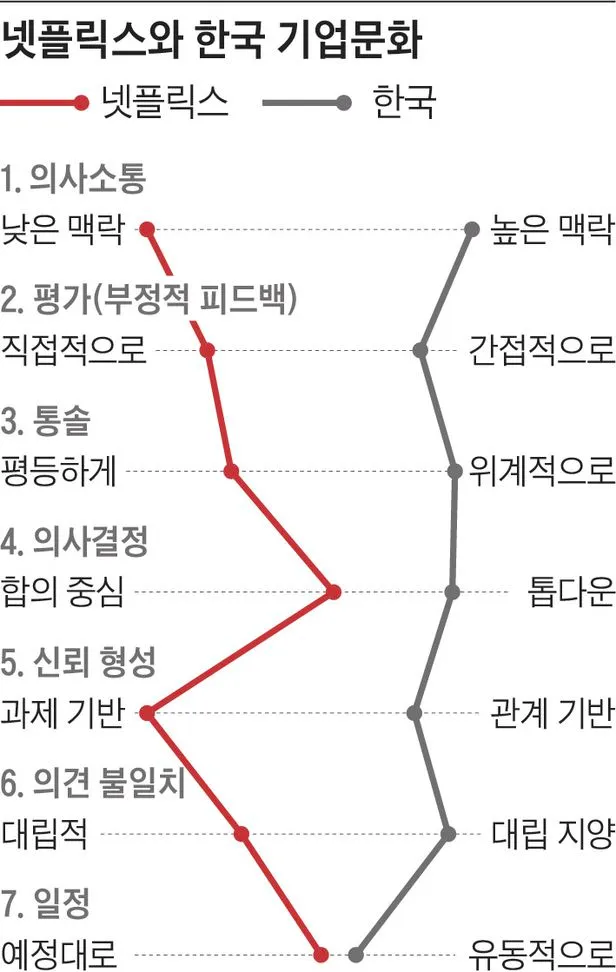
We also need to rethink the direct communication style we loosely call 'American style.' Even within Korea, don't we build stereotypes about the culture and personalities of people from Jeolla, Gyeongsang, and Chungcheong provinces?
Members of a company expanding into global markets need to be ready to communicate with foreign clients and teammates at any time.
Generalizations can't explain everything, but I felt it's essential to know what communication styles and cultural traits each country has.
Verdict: a textbook on 'freedom and responsibility' for a creative company culture
Lately, content showing the gap in work values between younger and older generations, like SNL Korea's 'MZ Office' sketches (which poke fun at Gen Z office workers), has been drawing a lot of interest.
The most interesting part to me was how people debated 'the problem of wearing AirPods during work hours' as if there were a correct answer.
Depending on the nature of the company's products and services, the role, and how people communicate and take responsibility for their work, couldn't the answer go any number of ways?
Company culture is fundamentally built through the actions of every member, led by the leaders who set the company's direction.
For 'freedom and responsibility' to take root in a Korean society that has run almost entirely on process, I think everyone needs to understand the pros, cons, and characteristics of each approach, and above all its purpose, and talk about it.
In that sense, this book deliberately emphasizes the extreme side of 'freedom and responsibility' to start a conversation with people.
"Here's another way. Whether to do it, and how, is up to you."


